• Skip to main content
  • Skip to primary sidebar

Mike Hohnen

Coaching for personal growth, change and development

  • ABOUT
  • SERVICES
  • LIBRARY
  • COURSES
  • LOGIN
  • BLOG

General

The real key to creating the eternally fantastic experience

April 14, 2022By Mike Hohnen

The Kano model teaches us that a service experience has 3 layers. There are basic attributes that need to be in place and that all services in a given category need to have to even qualify as a service. Then there are the performance features, attributes that define the better experience from the very basic experiences.  And finally, there is a category of attributes that we call delighters. Things that make our most loyal customers come back again and again. Not only do they come back, they also tell all their friends.
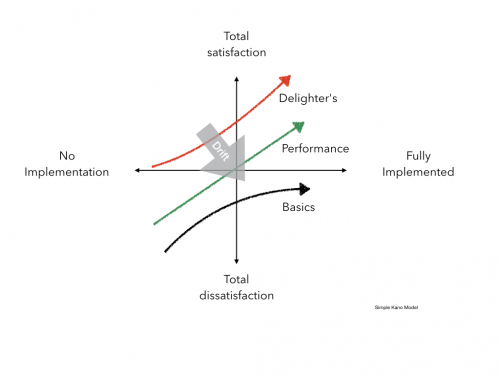
But as we saw in my previous blog post, the trouble with delighter is that they have a tendency to fade over time.   There is this notion of drift. Free high-speed internet in a cafe is a great example of this. So this puts all service providers under pressure to constantly innovate. They need to come up with new ways to delight their audience or risk fading into oblivion.

But there is actually another way to do it. There is one type of delighter that somehow never goes stale, that always stays fresh, and that is incredibly difficult for your competition to copy.

The key to understating this is likability.

Think about your own patterns. There are some services that you’re frequent not because of their physical attributes or technical specifications. You may even visit these services despite them not being quite up to par on some of these physical attributes. But there is one or often a whole crew of people that you find likeable. When I lived in Cape Town, we often used to go to Roberto’s. It was not the smartest cafe in town. It was also not the most elaborate culinary experience. But Roberto’s had one thing none of the smart cafes could match; there was Roberto and Roberto was immensely likable. Ah, you may be thinking, but that is a question of DNA, the Italians, the Greeks they know how to do to that, the rest of us don’t have those genes.

Not true.

As Rohit Bhargava explains in his lovely book Likeonomics, research has made the secret available. We know the components of likability and we can apply them to our own way of working and when can train our crew to practice these principles as well.

The key ingredients are: Truth, Relevance, Unselfishness, Simplicity, and Timing.

– Truth: you trust them. When the waiter says the special today is delicious, you know he would not say it if he did not actually mean it. He knows you and when he says you won’t enjoy that wine, you are so grateful

– Relevance: The service provider is not trying to upsell you like a robot (I so hate that expression “upsell”).  They make relevant suggestions that actually enhance your experience.

– Unselfishness: They go out of their way no matter what to make sure that you have a great time, even if it is not always the most convenient for them. A hotel where I have conducted workshops recently has two crews working the restaurant. One crew always sets the lunch table for my group in the window area where there is a pleasant view and lots of light. But it is the furthest from the kitchen. The other crew always sets the lunch table at the other end of the restaurant, not nearly as nice.  But it’s closer to the kitchen. One crew is likeable, the other one much less so. It comes through in all the little details of how they work because likeable is also an attitude.

– Simplicity.  As my vegetarian chef friend says to create a great salad, use only three ingredients; that is what makes it delicious and elegant.  As opposed to the salads where they dump the whole fridge into your salad bowl, they mean well I know, but…

– Timing:  The person servicing you understands empathy. They are aware of what is going on for you and they adapt their service delivery to suit you.  They understand the difference between coming in for dinner before a movie and coming in for dinner to celebrate your spouse’s birthday. And that is all about timing.

Now think again about some of those service experiences that you keep returning to again and again. I will bet you that it is because they are likeable.

And if you can implement these basic ingredients into your service experience, you have discovered the Holy Grail of delivering fantastic service experiences.   The concept is simple. The execution is what makes it hard.

Check out the book: Likeonomics: The Unexpected Truth Behind Earning Trust, Influencing Behavior, and Inspiring Action


If you are not familiar with the intricacies of the Service Profit Chain, we have a special treat for you:

You can download Mike’s book Best! No need to be cheap if … for FREE using this coupon 8WG55DP7C3. This is only available for a limited number of 30 people so first come first serve!
Download the book now!

Filed Under: Foodservice, General, GROW, Learning, Service Profit Chain Tagged With: customer experience, Customer Loyalty, Customer Value, service

The paradox of becoming a perennial service experience

April 13, 2022By Mike Hohnen

I spotted at least 10-15 new restaurants, cafes and other food related concepts on my walk downtown yesterday. I love the raw courage, energy and pure optimism many of these new service ventures exude.  They are brave because the reality is that by next summer, most of them will be struggling and many of them will already be gone.

And then once in a while, there is a survivor, a business idea that makes it through that first critical 2-year hurdle and becomes a viable stable business.  But that is just the first hurdle, the real test is to make it past the 5-year mark and beyond.

So what does it take?

You need to do two things equally well. On the one hand, you need to be extremely consistent in the way you deliver your product and at the same time, you need to be constantly renewing and innovating. That is the wicked paradox and that is why it is so hard to do.

One way to understand this is to use the Kano model.

Quickly explained, you could say that our goal is to reach total satisfaction, and avoid any dissatisfaction. In order to reach that goal. I will need to ‘implement something’. Certain things need to be in place.

If we stay with the simple example of the coffee shop, there are certain basics that need to be in place in order for you as a customer to even consider this a coffee shop. Tables, chairs, coffee, decent hygiene. If these basic are not there and well functioning, you would not even consider setting foot there. But that does not mean that more tables and chairs and scrubbing the floor even cleaner are going to attract even more customers.

It will take something more than just the basics.

You will need to implement attributes that we could call performance items. For a cafe to be considered a possible option for me. it would need to have high-quality coffee, friendly helpful staff, a selection of light bakery items etc..

This, of course, is individual and subjective. Now in my case, I can easily think of a dozen coffee shops that would fulfill these performance criteria. But there are a few coffee shops in town that I will actually go out of my way to visit. Not only do they get the basics right, they also fulfill my performance criteria AND they have something that delights me, a feature that I find unique and special for this place and that few others have in the same way.

But these needs are layers in order of priority. One layer builds on the next. It’s no use focusing on the delighters and neglecting the basics.

So the need for consistency is about the ‘basic’ and especially the ‘performance’ items. If they are not stable, you’ll very soon get tired of a place. If most days the coffee is great but sometimes it’s not, that is the end of that. You find somewhere that is consistent. Because the main reason we come back to a service experience is that we would like more of what we had on the previous visit. This is a fundamental customer need that we must never forget as service providers.

But at the same time, in the Kano model, there is also this notion of ‘drift’. Maybe, 6-7 years ago what really delighted you about a certain cafe was that it had free, no code high-speed internet connection (and it was one of the few that offered this in your area). Then 2-3 years ago, you started thinking of the free high-speed internet as a performance item, most of the good cafes had that. And today you probably consider that internet connection is as basic as the tables and chairs, and if it is slightly inconsistent in its performance, you will switch to a cafe that does have a stable internet connection.

So the service attributes that start out as delights, over time drift and become first performance items and then just basic. The reason for this is that customer expectation mature and competition is constantly copying the best delighters from each other.  That puts us under constant pressure to renew ourselves to continuously think up new delighters while skilfully maintaining our performance and basic attributes.

This over time becomes a delicate balancing act. What to add, what to maintain and what to let go. It can only be done successfully by being very ‘close’ to our customers. We need to fully understand why they chose us, and how their preferences are evolving!

If we are successful doing that, we achieve the nirvana of a great service concept and become perennial. My favourite example of this is the Danish Museum of Modern Art in Louisiana, it has existed for more than 50 years. There are certain things that are rock solid consistent and at the same time, they are always reinventing themselves. Brilliant!




If you are not familiar with the intricacies of the Service Profit Chain, we have a special treat for you:

You can download Mike’s book Best! No need to be cheap if … for FREE using this coupon 8WG55DP7C3. This is only available for a limited number of 30 people so first come first serve!

Download the book now!

Filed Under: Foodservice, General Tagged With: business, customer experience, service, success

Would you like the people around you to take better decisions?

June 29, 2017By Mike Hohnen

Probably.

The better decisions they take, the easier your life becomes. That is the bottom line.

So how can you help them do that?

It’s all about awareness as we discovered in last week’s post. They need help to raise their awareness about their own decision-making process.

How often do you review decisions taken by your direct reports together with them? Other than maybe telling them that whatever they decided was in the good/bad category?

As you may remember, this is a point I have made several times in this blog. We don’t automatically learn much from our experiences. If we did, we would never make the same mistake twice, would we? We only learn from our experiences when we take the time reflect on them.

But in a busy service environment, reflection is not top of mind. Fire-fighting is more the mode we are in. The mantra seems to be: Do something if it works fine; if not, try something else. It puts out the fire most of the time but we don’t learn a lot from the process.

So instead of getting frustrated next time one of your people makes a less than perfect decision, try sitting them down for a chat. Make it clear that this is not a reprimand but a learning session. Use a reverse GROW process as the framework for the conversation.

  • What were you trying to achieve? (Goal)
  • What was the reality of the situation? (Reality)
  • What options did you have? (Options)
  • What did you decide? (Will)

In my personal experience, the two key points in this discussion are:

1) What was the reality of the situation?
Did they jump to conclusions, or confuse their assumptions with facts? Often it turns out their decision was based on everything but the reality of the situation.

2) What options did you have?
As humans, we have a tendency to stick with the first solution that pops into our head. “Ahha got it, I will do this”. Maybe the first solution is the right one, that flash of inspired insight. But more often than not, that first idea that pops up has overlooked other possibilities.

This is where it can be helpful to explore with them what other options were actually available. It will help them understand that next time, it might be worthwhile to pause for a moment and try and come up with a few more alternatives.

When we do this, we help our colleagues see how their decision-making process operates. Now they have a basis for getting better.

This works well in one-to-one sessions. But we can use exactly the same review process to consider decisions that we have taken together. The key here is to avoid blaming any individual but looking at the collective decision-making process in order to learn from it.


This the fourteenth blog post in a series where Mike is exploring: Why is it important to develop not just yourself but also the people around you? You can read other posts in this series on Mike’s blog.

Building capacity is at the heart of the Service Profit Chain. If you are not familiar with the intricacies of is model, don’t forget to check out Mike’s online courses where you will find a lot of great tools, resources and knowledge on Leadership Development and The Service Profit Chain.

Filed Under: General Tagged With: decision, decision making, leader, Managing Others, Team, Team Leadership, team performance

One thing that will dramatically improve your performance

July 5, 2017By Mike Hohnen


Think about it for a moment…, what is one thing you could work at that would dramatically improve your performance as a leader?

My theory is that most of us could improve the quality of our decisions. When I look at my own life and try to identify some of the main causes of difficult times, frustrations, etc., they can quite clearly be attributed to decisions that I have taken or possibly not take, which is in itself a decision.

So why is it hard for us to take consistently great decisions?

  • We are not as rational as we would like to be. We like to think of ourselves as super rational, but in reality, we are not. We make up a story that explains the irrational decision we took in order to convince ourselves and others how rational we are. Often, not always, it is bullsh*t.
  • We don’t understand what is really going on. We are looking at a situation through our own limiting mental models, and we confuse what in reality is just our perspective with reality or the truth.
  • We don’t take the trouble to gather enough information. We take decisions based on a few facts plus our own gut feeling. Sometimes it works brilliantly, but more often than not is doesn’t. A classic in this category is confusing our assumptions with facts. We think we know, but in reality, we are just assuming, and as my favourite coaching colleague from the US always used to say: Never forget Mike, that assumption is the mother of all f… ups.

So how do we work on improving the quality of our decisions? Once again it comes back to awareness. What we are aware of we can control, what we are not aware of controls us.

So the first thing to do is to start a decision journal.

Dedicate a notebook to this. And whenever you need to make a consequential decision, take a moment to think through: What are the options? What is your decision and what do you expect to happen? Make a note as well of your current state (tired, happy, stressed or whatever). Make space on the page for you to come back at a later time and note down what actually happened and what your key learning has been.

Start the decision journal today, by which I mean get it ready and commit to using it. Then the next time you need to take a significant decision, take the trouble to document it. Then on a regular basis go back and review your notes. Is there a pattern? What are you learning?

If you would like to get more sophisticated about this, check out this blog post from Farnam Street.

My personal experience of doing this is that I became aware that I had a tendency to take a certain type of decision very quickly, typically when something had not turned out as I expected and I felt an urgent need to correct the course. But what I had not previously noticed is that whenever something turns out different than what we expect, it triggers an emotional reaction and that emotional reaction would often tilt my decision toward the first idea that came into my mind.

Once I became aware of this, I have tried to postpone that kind of decision, to give myself time to get a different perspective, to resist the urge and that has definitely prevented me from a few bad decisions in the past 6 months.

Proving the point that more than anything, becoming aware of our own decision-making process helps us avoid the really bad decisions more than it makes us genius decision makers, but already that is not too shabby an outcome for many of us.

Once we have the decision journal in place, it’s time to practice getting better. A good place to start is to read Decisive: How to Make Better Choices in Life and Work by Chip and Dan Heath.

And what about your team? What is the one thing that really causes you frustration when you look at the people who report to you? If you in any way resemble many of the leaders that I coach, you will say: The quality of their decision… If only they could be trusted to take better decisions, my life would be so much easier.

Can you help your team make better decisions as well? Absolutely! It’s all about awareness, remember. We will have a look at how to do that in next week’s blog post.


This the thirteenth blog post in a series where Mike is exploring: Why is it important to develop not just yourself but also the people around you? You can read other posts in this series on Mike’s blog.

Building capacity is at the heart of the Service Profit Chain. If you are not familiar with the intricacies of is model, don’t forget to check out Mike’s online courses where you will find a lot of great tools, resources and knowledge on Leadership Development and The Service Profit Chain.

Filed Under: General, GROW, Leadership, Leadership/Management, Learning, Service Profit Chain, Training & Development Tagged With: decision, decision making, leader, Leadership, Learning

Are you an accidental diminisher?

April 14, 2022By Mike Hohnen


In my previous blog post, we looked at two very different leadership approaches: multipliers vs. diminishers.

In this blog post, we’ll take a closer look at the diminisher.

So how much output do we get from someone when we hire them to do a fair day’s work?

Well, there is quite a lot of research that indicates that on average, we are getting somewhere between 30 and 50% of what people are actually capable of.

This is also reflected in the Gallup engagement research that shows that +/- 65% of the workforce is not particularly engaged in their work. If you are not engaged, you are probably also not giving it your best.

So what are the barriers for our people to give their best? The top three, according to the research are:

  1. Rules, regulations, and structure in the organisation
  2. Lack of feedback and encouragement
  3. The leadership style of the immediate supervisor

So to put it in a nutshell: If you are not getting max output from your team, it is probably because of you.

Yes, let that sink in for a moment.

That is not because you are a slave driver with psychopathic tendencies, at least I hope not.

More likely your are just an accidental diminisher. Accidental because when you have a diminishing impact, you are likely to be completely unaware of it and probably the last to know.

The first thing you need to think about is your own assumptions and beliefs.

You see, diminishers see intelligence as based on elitism and scarcity. Diminishers appear to believe that really intelligent people are a rare breed and that they are of that rare breed. This naturally leads them to conclude that they are special and that other people will never work out what to do without them.

They also seem to follow a logic that says people that don’t ‘get it’ now probably never will. Therefore, I need to do all the thinking around here.

This is what Caroll Dweck, author of Mindset, would call a limiting mindset.

The Multipliers, on the other hand, have a growth mindset, which is a fundamental belief that basic qualities like intelligence and ability can be cultivated through effort.

Multipliers get more from their people because they are leaders who look beyond their own genius and focus their energy on extracting and extending the genius of others. And they don’t get just a little more back; they get vastly more.
_Liz Wiseman

As we all well know, our assumptions and beliefs govern our behaviour.

So the diminisher typically displays some or all of the following behaviours:

  • Micromanage things
  • Do most or all of the talking at team meetings
  • Have the answers and ask few questions
  • Be judgmental and critical of others
  • Create stressful environments that often do not feel safe
  • Take fast decisions (as opposed to getting everyone buy in)
  • Drown the team with new ideas and initiatives

So here are a few questions to ask yourself and reflect on:

  • How might I be shutting down the ideas and actions of others, despite having the best of intentions?
  • What am I inadvertently doing that might be having a diminishing impact on others?
  • How might my intentions be interpreted differently by others?
  • What messages might my actions actually be conveying?
  • What could I do differently, that would make more space for the to contribute and grow?
  • These questions can be tricky to get feedback on from your direct reports, for obvious reasons. But what you can ask when there is the right opportunity is: Is there anything that I could do differently that would help you do a better job?

And then listen very very carefully.

Check out Lis Wiseman’s book for yourself: Multipliers, Revised and Updated: How the Best Leaders Make Everyone Smarter


This the twelveth blog post in a series where Mike is exploring: Why is it important to develop not just yourself but also the people around you? You can read other posts in this series on Mike’s blog.

Building capacity is at the heart of the Service Profit Chain. If you are not familiar with the intricacies of is model, don’t forget to check out Mike’s online courses where you will find a lot of great tools, resources and knowledge on Leadership Development and The Service Profit Chain.

Filed Under: General, GROW, Leadership, Leadership/Management, Learning, Service Profit Chain, Training & Development Tagged With: leader, Leadership, management, manager, Managing Others, Team Leadership

Are you a Multiplier or a Diminisher?

June 11, 2017By Mike Hohnen

If you want to reap the full benefits of your investment in training courses, you need to make a plan for what you are going to do when the course is over, because that is when the magic really happens.

We know from the 70:20:10 model that most of our learning comes from what we do on the job. That is the 70%.

And we also know that if we always do what we always did, we will always get what we always got.

And even that is not quite accurate because research shows that if we just do what we do, without trying to get better, we will actually regress, and gradually get slightly worse. But that is another story.

So we need to inspire our team members to do something different than what they have always done. That is why we send them on a training course.

But if these training programs are just seen as an entertaining stand-alone event then they do not help us much, except maybe for a few high performers who have the drive to take the materials and build their own implementation program.

So assuming that only a few of our team players are so called high performers, we then need to manage how we can best support the ‘normal’ team members in actually trying out their new knowledge, experimenting, getting feedback and gradually improving in order to ultimately get really good at whatever it is they learnt on the training course. That was, after all, the objective of the whole exercise.

Your approach makes a difference.

The key differentiator in this post-course learning phase is the team leader or the immediate supervisor.

Immediate supervisors, whether they are CEOs, VPs or floor managers come in basically two categories: Multipliers and Diminishers, writes Liz Wiseman, author of the book “Multipliers”.

Multipliers are essentially leaders who make everyone around them smarter, they consciously invest in the success of others. Their basic attitude is that people are smart and will figure it out and when they do, they become even smarter.

Multipliers ask lots of questions – Diminishers have all the answers.

Diminishers, on the other hand, create dependency. They often jump in and save the day. They drive results through their personal involvement and they are never shy to remind everyone how much smarter and more capable they are. When they do that, they drain the energy and motivation from everyone around them, and ultimately that reinforces the dependency.

Multipliers make sure that we get a high return on our training investment whereas diminishers time and again end up reducing all the time and effort that has been invested to nothing.

The key to being a great multiplier is to get people to think for themselves. They will never develop that ability if you always tell them what to do and how to do it. Learning means exercising some degree of choice, as opposed to working to a predetermined script. When you exercise your choice, you have an experience. That experience gives you feedback on how well you did. For most of us, this is a deeply motivating process. So building our capacity based on what we learnt on the course means trying things.

So the multiplier makes sure to hold a debrief meeting when a team member ‘returns’ from a formal training program. The purpose of the debrief is to establish what the team member is now going to work on in order to reinforce and build on the knowledge or inspiration that has been given in the course.

You’ll never change your life until you change something you do daily. The secret of your success is found in your daily routine.
– Johan C. Maxwell.

As with so many other new things, baby steps are the key. Don’t try and implement everything at once but make a plan. It’s the good old 20/80 principle again. What would be a small thing from the course that would make a big difference? That is a great starting point. Once we have that up and running, we move to the next item on the list, and step by step we build our capacity and performance. Use the GROW model to set it up.

So are diminishers evil egotist? No, most diminishers don’t even realise that they are draining the team. They actually mean well. They think they are being helpful. Next week, we will take a closer look at how not to fall into the trap of becoming a diminisher.

Check out Lis Wiseman’s book for yourself: Multipliers, Revised and Updated: How the Best Leaders Make Everyone Smarter


This the eleventh blog post in a series where Mike is exploring: Why is it important to develop not just yourself but also the people around you? You can read other posts in this series on Mike’s blog.

Building capacity is at the heart of the Service Profit Chain. If you are not familiar with the intricacies of is model, don’t forget to check out Mike’s online courses where you will find a lot of great tools, resources and knowledge on Leadership Development and The Service Profit Chain.


Filed Under: Coaching, General, GROW, Leadership, Leadership/Management, Training & Development Tagged With: Action Learning, course, Learning, manager, training and development

A great course gives you just 10% of what is needed to grow the team.

June 13, 2017By Mike Hohnen

Participants attending the GROW leadership course

Quite a few years back now, the Center for Creative Leadership developed the 70:20:10 model for learning and development. The research behind the model shows that most of our learning (70%) stems from hands-on, on-the-job experiences. We mainly learn from what we do.

When we learn from others, it is typically in the form of coaching, mentoring and various forms of collaboration. This accounts for roughly 20% of our learning, and finally, the last 10% of our learning is based on courses, books, lectures etc., what we also call formal learning.

This then raises the question: Should we just forget about the formal part? Are courses and books just a waste of time?

If we look at the research on how high performers learn and develop, it becomes clear that there is a pattern.

High performers are typically quick to grasp the basics and when it comes to new learning, they often get this in the form of more formal structured courses, training or books.  The 10% is their foundation. That is what they use to build their development on.

What makes them high performers is that the new knowledge inspires them and drives them to want to practice. They spend hours trying out their new learning. Through trial and error, self-testing and feedback, they gradually improve their capability.

They are also not shy to seek the support and help of colleagues. They may even take a coach for a period in order to make sure that they really get to master whatever the new skill is (Just look at any top performer in music, acting or sports and you will see exactly this pattern). They are not born like that, they work hard to get there.

It is their drive to improve that makes them high performers.

So back to the question about formal courses. Do we need them?

Yes, we do.

Because we need that basic input, that initial inspiration. But we must understand that if we do not reinforce the message and help set the scene for the additional 70% on the job learning and the 20% collaborative learning or coaching, then we have wasted our time and efforts. 

That means that if you, as a manager, have had one of your team members on a course, you need to think about how you are going to support that person in developing and improving their skills, building on the foundational knowledge that they have acquired on the course.

Most of them are probably not what we would define as high performers, they are just great team members. And therefore, they do not have the drive or natural inclination to do this by themselves.

The knowing-doing gap
The first step in that process is to have a follow-up conversation with your team members when they return from the course.  What have they learnt and most importantly, where do they see the knowing/doing gap? What is it that they now know, but that they are currently not doing?

How can you then, as this person’s manager, make sure that your team member gets to practice these new aspects? This takes us back to our famous GROW model.

If you have forgotten what that is about, check it out here.

You multiply the value of the course experience by at least 10 times if you help them actually implement what they are learning. But don’t forget, no feedback, no learning.

If you want to further maximise their learning, make sure that they team up with one or two others who also did the course and have them form an action learning triad or let them have the support of an experienced coach. That way you will also make sure you have covered the 20% that comes from collaboration and/or coaching.

In my experience, this is the way to create sustainable change. The key is not the learner as much as their immediate supervisor.

In this context, the immediate supervisor comes in one of two basic types: the ‘Multiplier’ and the ‘Diminisher’. Being one or the other makes all the difference, as I will explain in next week’s post.


This the tenth blog post in a series where Mike is exploring: Why is it important to develop not just yourself but also the people around you? You can read other posts in this series on Mike’s blog.

Building capacity is at the heart of the Service Profit Chain. If you are not familiar with the intricacies of is model, don’t forget to check out Mike’s online courses where you will find a lot of great tools, resources and knowledge on Leadership Development and The Service Profit Chain.

Filed Under: Coaching, General, GROW, Leadership, Leadership/Management, Learning, Training & Development Tagged With: coaching, Learning, training and development

The secret to faster team development is a shorter year.

June 3, 2017By Mike Hohnen

Seriously.

Let’s first deconstruct how do you know what to work on in order to ensure that you and your team are developing?

One way to get a grip on that would be to ask yourself: “If I was doing this reflection one year from now and looking back on the year that has passed, what should have happened during this past year in order for me to feel that I and/or my team have made serious progress?”

Because as Peter Drucker famously said: “What managers manage is change. The rest is admin.”

So that is the project.

That is what needs to change in order for you and/or your team to feel that you are actually developing. And as I have written about earlier, development is not only important because it means that we are making progress, it’s a key to our well-being, motivation and job satisfaction

But a whole year’s worth of change is a lot of change. So what typically happens is that we undershoot the runaway and don’t get to where we wanted to be. It was a nice dream.

We fall short of our own expectations.

The problem is not that we are being over ambitious, we need to be ambitious. The problem is that we are trying to chew off too big a bite.

So now ask yourself the same question but reframe it to just 3 months, the magic 90 days: If I was doing this reflection 90 days from now and looking back at these 90 days that have passed, what should have happened during these 90 days in order for me to feel that I and/or my team have made serious progress?

This is a horizon that is within our reach, we can almost see the contours of the finish line as we get going. It’s not that far, we can do this. We have set a goal that we can see ourselves completing within a reasonable time frame.

So personally I have given up yearly goals and targets. I have a long-term plan, which is more a direction that I am heading than it is a measurable goal. With that direction in mind, I work in 90-day sprints. It gives me a completely different sense of accomplishment.

Try it out for yourself.

And if you need more resources to get you going, here are my favourite tools:

Best self 90-day planner – This is at the core of my productivity.

If you would like to study this 12-week-year principle more in depth, here is a great book that originally inspired me:

The 12 Week Year: Get More Done in 12 Weeks than Others Do in 12 Months


This the ninth blog post in a series where Mike is exploring: Why is it important to develop not just yourself but also the people around you? If you would like to read other posts in this series, don’t forget to check out Mike’s blog.

Filed Under: General, GROW, Leadership, Leadership/Management, Learning, Training & Development Tagged With: Development, Goals, Team, team performance

  • « Go to Previous Page
  • Page 1
  • Interim pages omitted …
  • Page 8
  • Page 9
  • Page 10
  • Page 11
  • Page 12
  • Interim pages omitted …
  • Page 42
  • Go to Next Page »

Primary Sidebar

Search here

The Legal Stuff

Terms & Conditions

Privacy Policy

© Copyright 2025 Thoughts4Action cc - Privacy Policy - Terms & Conditions

All your work challenges are really relationship challenges

Get fresh perspectives and practical wisdom on building authentic professional relationships that make your life easier.

Join my newsletter list here (published once a month)