• Skip to main content
  • Skip to primary sidebar

Mike Hohnen

Coaching for personal growth, change and development

  • ABOUT
  • SERVICES
  • LIBRARY
  • COURSES
  • LOGIN
  • BLOG

Mike Hohnen

Dysfunctional management teams are a bigger problem than you might think.

April 13, 2022By Mike Hohnen

It’s Monday morning. It’s time for the weekly management meeting. As they filter through the door, they look as if they are attending a funeral. They take their usual seats, open up their laptops and locate the agenda, not that they need to, they know it by heart, it’s always the same 5 items and the CEO starts out with item 1 and every one goes through the usual motions. The 5 people on the management team have been together for the past 3 years. They know the routine by heart. In fact, they know it so well they can almost predict how each of them will answer the questions from the CEO.

If you ask them individually, they all dread these meetings, they just want them to be over and done with. The CEO especially is frustrated. This is his team and they are so far from what we would consider a team as you can be. They are just a group that convenes to share some information that could probably have been just as easily shared on an intranet.

So some people would argue to change the meeting format, make it livelier, sit in bean bag chairs and use lots of post-its etc. But that is not the core problem. When the meetings play out like this, it is just a symptom of something much more serious going on. The core problem here is relationships, the top management team at best don’t have healthy relationships with each other. In the worst cases I have seen, I would even characterize them as toxic and dysfunctional.

Furthermore, the problem here is not so much that they have boring meetings that they all dread, that is their problem you could say. No, the real problem is that if they have rotten relationships with each other, it filters down throughout the organisations and contributes to the dreaded silo thinking. Invariably, employees take sides with their team leader and the relationships across departments suffer accordingly.

Not the best scenario when we are trying to create end-to-end seamless and breath-taking customer experiences.

Company culture starts with the culture in our management team; that sets the tone. That culture is primarily defined by the relationships in that group. If you really want to create a strong culture, you will need to invest time and effort in improving the relationships on your management team. Until you do, not much will change.

What is your experience of top management cultures and how they influence the rest of the system? Leave your comments below or contact me, I would love to hear your thoughts on this.

Filed Under: General, GROW, Leadership, Leadership/Management Tagged With: leader, Leadership, management, management team, manager

The story your employees tell their friends and family at the end of the day

September 25, 2017By Mike Hohnen

We can look at the employee experience from 10.000 ft. as we have done in previous posts (great cultures, conversations and employee life cycle).
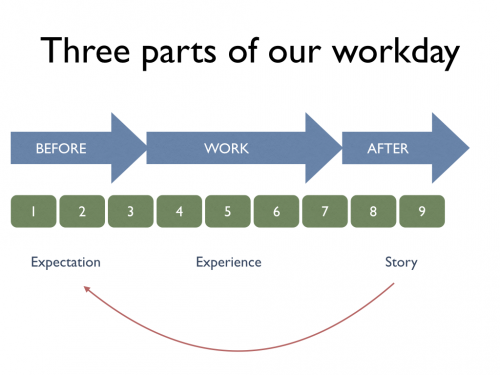
Or we can go down real close up and look at the day-to-day experience.

Using the same tools and principles from Service Design thinking that we use in mapping the customer journey, we can map the employee journey over the day. When we look at it that way, a workday has three sections: Before work, work and after work. In each of the sections, we have a number of touch points related to whatever the situation is.

At each of the touch point, there will be 3 things going on: doing, thinking and feeling. The three elements are interdependent. Change one and it influences the other two.

Let’s begin with the end.

What happens at the end of the day? We go home for dinner or maybe off to the pub for a drink and invariably we get the question: So how was your day? And then we tell our story. Sometimes we may even feel a strong need to tell the story without anyone asking to hear it.

Our stories are interpretations.

According to Daniel Kahneman, the remembering self uses stories to make sense of the world. As soon as we experience something, we fit it into the story in our heads. What we retain from our experiences is a story.

Therefore, when we recount a memory, we’re sharing the experience of the story we created, not the actual experience.

And what defines stories?

Most of the individual moments of an experience are lost and don’t make it into the story we remember, except for changes, significant moments, and endings.

Those three key elements are what you need to be thinking about when you think through the employee journey. All three have a direct impact on their feelings.

Feelings often change as a result of shifts in our circumstances. When things go as we expect, our feelings are stable. When things go better, we are more positive and when they go worse than expected, we tend to become more negative. (Unless we are very aware of how this works and know how to deal with our own mindset, but that is a different story). The same goes for significant moments. If they are positive, they influence us in a positive way; if negative we also become negative. That endings are so important may come as a surprise to most people but it shouldn’t.

But if you think about it, when was the last time you saw a movie or read a book that had a depressing ending? There are not a lot of them around. The reason is that if you watch a movie that ends badly, you are not very likely to recommend it to your friends and family. It can be gruesome and depressing most of the time but it needs to end well otherwise you will be disappointed.

Feelings drive engagement.

So in the same way that we try and maintain stable blood sugar levels throughout the day by paying attention to what we eat, we should as managers be aware that maintaining stable emotional levels on our team has a lot to do with how we manage changes, significant moments and endings.

Changes in the day are inevitable, but could we reduce the impact of some of them. Be more clear in our communication or issue; heads-up warnings about things we think might happen. If we do, we make it easier for them to cope.

Significant events, some could just happen we know that but could we consciously create more positive significant events?  Take five minutes to gather around the coffee machine and celebrate something. Ring a ships bell when we sign up a new client and pass around the cookie jar. There are lots of opportunities in a day to make certain moments more significant than others.

The way the day ends not only shapes how an employee perceives the whole day.  How the day ends also contributes significantly to their expectations for the following day. The key question we should be asking ourselves is: do we send our people home and the end of the day in a mood where they look forward to coming back tomorrow?

A hotel head of housekeeping I have been coaching came up with a lovely way to do this. Every afternoon at 3 pm, she gathers the housekeeping team in the restaurant, serves them ‘guest-coffee’ (this was important she told me) and a pastry. They would spend the last 20 min of their shift having an informal chat about the day and how everyone feels. She tells me it has contributed to improving the relationships between them and their sense of being in this together.

What can you do to create great endings for your team members?

I would love to hear any ideas or real life examples of this if you feel like sharing, email me here.

Filed Under: General, Leadership/Management, Service Design Tagged With: employee, employee engagement, Employee experience, ending

Great cultures are created with principles not rules

January 25, 2019By Mike Hohnen

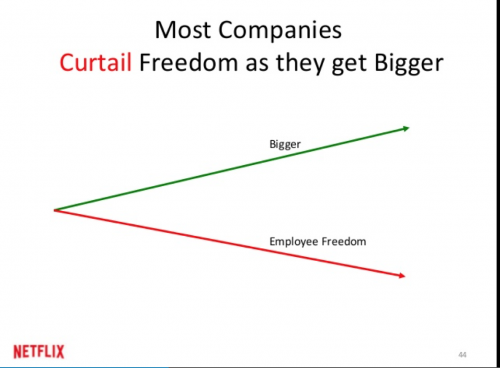
Source: Netflix -https://www.slideshare.net/reed2001/culture-1798664

‘Another, customer complaint!’ thought the manager. ‘And what a stupid one at that. Some of our people just don’t get it. We will have to create a new rule for this kind of situation.’ And so he does. Up goes the memo on the information board, where it joins quite a few other new rule memos.

But rules only work when we can clearly define the situation and set clear boundaries. However, what we are looking for in our customer experience is personalisation. We want employees who are flexible in their approach and who can think on their feet. And with as few boundaries as possible… If there is one thing a customer hates, it is hard boundaries. ‘Sorry, sir that is not my section. Please ask your waiter.’

When we analyse why we create rules, it is not because we have a problem with the top performers. The top performers use their own good judgment to solve situations, which are typically also the situations that lead to praise and four-star reviews on social media. It’s the bottom 30% of the crew who need rules.

The more rules we create, the less room there is for good judgment.

The solution to the customer complaint is not to create another rule. It’s performance management, but not in the form of making a note for the yearly appraisal meeting, but here and now feedback and coaching. And, ultimately, if we have team members who don’t get it, they should not be on the team.

We can never create enough good rules to cover every situation. And even if we could, that would still not be the solution. Because top performers hate rules. What drives their engagement is autonomy, being able to use their own good judgement from situation to situation. And if you take that away, they will find somewhere else to work, a business where good judgement and personal initiative are appreciated.

But how will new employees know what good judgement looks like in our context?

This is where principles come in. Principles are the fabric of a great service culture. Principles frame what we believe around here. Principles are the foundation for our decision. Nordstrom, the US retail giant, has a very simple approach:

“Use your best judgment in all situations. There will be no additional rules.”

Southwest Airlines tell its employees: “You may do anything you are not uncomfortable doing in order to solve a passenger’s problem.”

Obviously, some people have better judgment than others. But that means that performance management is not about enforcing the rules but about helping people make better decision – and ultimately weeding out those who just don’t get it.

Get rid of the rule book and start thinking more about what  should be the guiding principles.


This spring we ran a series of blog posts around development, developing yourself and others. We have collected and edited those blog posts into a simple e-book that you can download below if you would like to explore this subject further.

Filed Under: General, Leadership, Leadership/Management, Learning, Training & Development Tagged With: Culture, customer experience, Employee loyalty, engagement, Leadership, Learning, Service Profit Chain

If you would like to change your culture, start a new conversation

September 13, 2017By Mike Hohnen

Often teams say to me: “We need to change the culture around here.” And they often have a point, because toxic cultures are very powerful and can often destroy all sort of great initiatives – and as we have seen in a previous post, culture is a huge part of engagement. But it also easily becomes a fluffy excuse for not doing anything. It’s another drama triangle where the big villain is the culture and we are just the victims of this culture. “Well you know, that is just the culture around here. There’s not much we can do about it.”

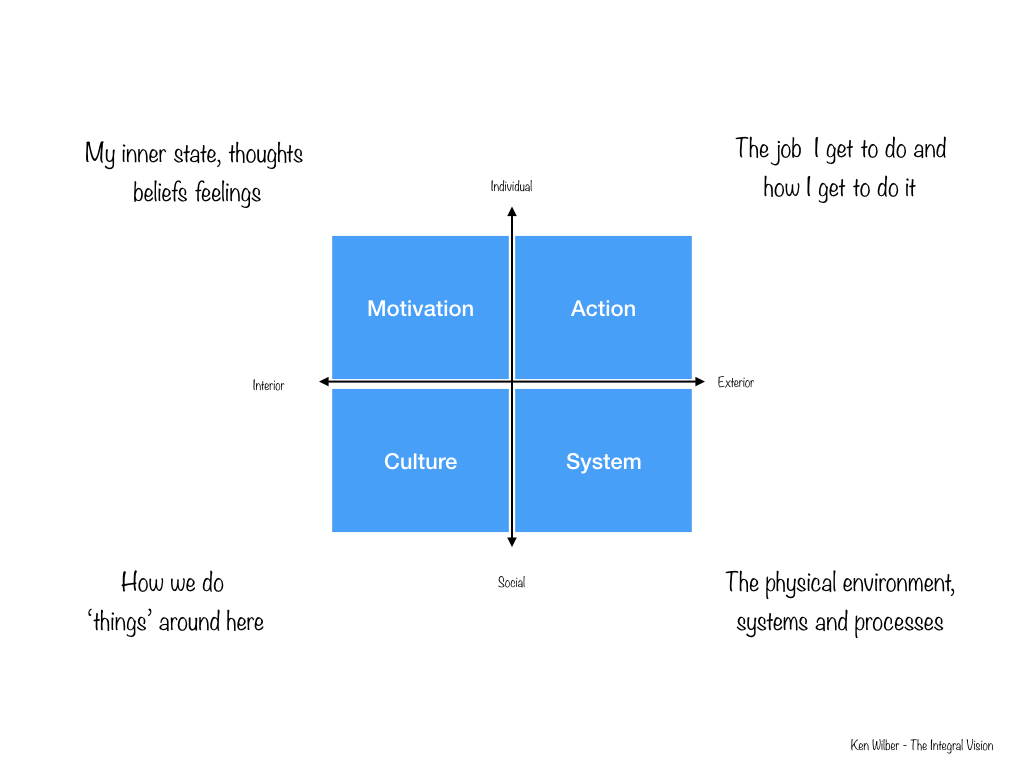

But how does culture emerge? What creates the culture?

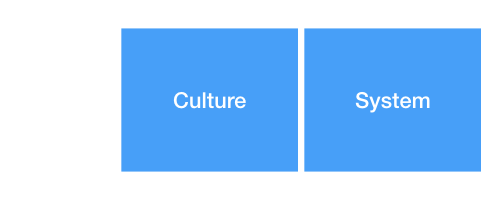
If you use the four quadrants we introduce in this blog post, then culture is influenced by:

– The attitude and behaviour of each individual

– The system or physical setting that we operate in.

If you are having a meeting with someone, the physical set-up has an influence on how the meeting unfolds. We could have the boss behind a desk looking down on the other party, or we could move to a sofa or we could even go for a brisk walk around the park. Each of these physical systems would obviously create a different feeling in that meeting. And if we run most of our meetings in a certain way … that creates a culture.

(I am known for insisting on having round tables or just circles of chairs for my workshops, and some people think I am being a bit silly in insisting ad nauseum about this. But I know from my 15 years’ experience that the setting creates a different feeling. It sets the tone. And when I am with a new group for the first time, this is the first step in creating a culture. A culture of conversations.)

Another aspect of culture is that, at the end of the day, our culture is the sum of the attitudes and behaviours that are present in our group over time. So first of all, each person needs to ask themself a crucial question: “In what ways am I contributing to this culture that I possibly don’t like?”

Secondly, how does each person behave? What they do and how they do it contributes to the culture. The more dominant or influential someone is in a group, the more their behaviour influences the common culture. This means that top management is key to the culture. After a few years, the culture becomes a mirror or reflection of the values and behaviour of the top person or the top management team.

So what can you do as a management team to influence the culture?

First, be very aware of your behaviour, including what you focus on, what you notice and comment on etc. All these things are cues that the organisation picks up and uses to try to decode what the culture is.

Secondly, change your conversations. More than anything, our culture becomes what we talk about. Take a look at your meeting agendas (and meeting formats) and think carefully about the conversations that you participate in during the day. What are we talking about?

But maybe more importantly, what do we never or very rarely talk about?

I spoke to a manager the other day who had just joined a large service organisation. He told me that when he was recruited, he was told all about the very customer-centric values the company has and how “we always put the customer at the centre of what we do”. “But,” he said, “I have been here for 6 months now and I have not had one single conversation about the customer experience. Every meeting is about financial KPIs. That is all we talk about.”

So, what do we need to introduce into our conversations if we would like to shift the culture? Where and when are we going to make the time and space for that conversation? Those are the crucial questions.

<<<<  >>>>

This spring we ran a series of blog posts around development, developing yourself and others. We have collected and edited those blog posts into a simple e-book that you can download below if you would like to explore this subject further.

Filed Under: General, Leadership, Leadership/Management, Learning Tagged With: engagement, Leadership, Service Profit Chain, Team Leadership

The employee experience needs to adapt to the employee life cycle

September 2, 2017By Mike Hohnen

The classical way to define the employee life cycle is: attract, recruit, onboard, develop, retain and transition. But that is the HR perspective, not the employee’s perspective. And as good service designers, we know that we need to consider the perspective of the ‘customer’ or user if we are going to be successful with our journey/experience design.

The life cycle will vary from industry to industry and of course from employee to employee. So good experience design would require that we do more research on this, in order to understand what it looks like in our case.

But here is what it might look like from an employee’s perspective.

Is this for me?
Attracted to a job proposition and wondering if it is for me.

Will I make it?
Entering into the application, selection, interview, and final negotiation process.

I made it!
The excitement of being chosen and starting the new job. Flooded with new impressions and ‘firsts’.The lunch canteen is amazing. Loving the attention I get as a newbie. (Or so one hopes.)

Am I good enough for this?
The first feelings of being overwhelmed. Am I good enough for this? Imposter syndrome. Do I belong here? Is this really for me? Feeling very much outside my comfort zone. Should I bail out and limit the damage?

Challenging but do-able
Feeling more secure in the saddle. Challenged and on the edge of my comfort zone, but in an exciting way. Giving the job everything that I have, and enjoying it.

Cruising – no sweat
The daily routine sets in, and most of what I do is well within my comfort zone. (Canteen is not nearly as nice as when I started.) Engagement may start to regress, through lack of challenges.

Is this it?
The first doubts start creeping in. I am always well within my (now shrinking*) comfort zone. This is no longer meaningful for me

From here there are two options: change your job or stagnate completely.

Experiences are all about managing customers’ emotions, as we have seen in previous blog posts on the subject of Service Design Thinking. The same principle applies to employee experience design. We need to understand the emotions that the employee is going through at each stage of the cycle.

When we review the above life cycle it becomes clear that the overall principle we need to look at is where people are in terms of comfort zones. Growth and development are keys to engagement and enthusiasm. But learning and growth happen just outside our comfort zone. We have the misconception that if we do the same thing for a long time we will get better and better at it. Not true. Research shows that, if anything, we stagnate or regress*. (Could you pass a driving test today? Probably not. See what I mean?) In order to get better we need to challenge ourselves and make a deliberate effort to improve. On the other hand, if we get too far outside our comfort zone we trigger fear, and then all learning and development stops as we move into “fight or flight” mode.

Engagement is essentially the product of the accumulated emotional experience. It is what we in a service profit chain terminology would call content. It is different from context (environment, salary and work conditions), which forms the basis of satisfaction but does not produce engagement. We can all have tricky and less than satisfying days, just as we can have fabulous days. But over time the key to engagement is: is this meaningful for me overall? Do I regularly find that I am at the edge my comfort zone, in a constructive and challenging way?

So the key to engagement and retention is to create an environment where the employee can safely switch back and forth between “challenging but do-able” and “cruising, no sweat” modes.

When looking at the employee life cycle in this way, it also becomes clear that as a manager you have a huge responsibility to know where your employee is in the cycle, and to do what you can to support that person in the best possible way. And that may even include helping an employee to move on to a new and more challenging position, if you have no more challenges to offer.


Filed Under: General, Leadership, Leadership/Management, Training & Development Tagged With: engagement, GROW, Leadership, service, Service design, service design thinking, Service Profit Chain

Why culture is not enough to save your employee experience

January 25, 2019By Mike Hohnen

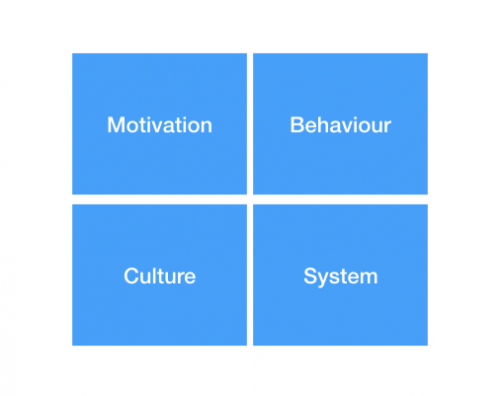
The four quadrants of the employee experience

Last week I argued that culture is an often overlooked and important part of the employee experience – and it is.

However, having a great culture is only part of the story – as we all well know, we can’t suboptimise ourselves to greatness.

A great employee experience is not about how high a fuzzy-feel-good factor you can score. It’s about sense making and meaning. Is this meaningful to me or not?

When things are meaningful, we thrive; when things become meaningless, we suffer.

When you look at it this way, it becomes clear it is not enough to make part of the employee experience pleasant. It is not about the free fruit or great lunch service. That is also important, but it’s also just another part – the same way that our culture is only a part of the whole experience.

So, if we recapitulate.

We are striving for high levels of engagement. Engagement emerges from an individual feeling of motivation, enthusiasm – call it what you like – but it is something that starts on the inside of an individual and it is influenced by the three other parts: culture, physical environment (system) and the job that we get to do (and how we are allowed to do it).

This is the very simple explanation why it is so incredibly difficult to achieve consistently high levels of engagement. If you are not hitting all the elements more or less perfectly, there is no engagement.

We can have exciting challenging jobs, but in a horrible culture that is not meaningful for very long. We can work in the loveliest of cultures, but where ‘nothing seems to really work around here’. That is also not meaningful. And, finally, we can build these beautiful work environments with lovely cultures, but everything is so controlled, right down to how I am supposed to do every little detail, and that is not meaningful either.

And, to top it off, we must, of course, mention the fourth variable – the individual. None of this works the same for everyone. Each individual has their preferences and their ideas of what is meaningful to them.

So, if you have a day where you feel frustrated that you have tried everything to create a great workplace, don’t despair! Getting it right is really hard, but if you manage to do so, the pay-off is amazing.

How is that for a meaningful challenge?


If you are interested in exploring what it takes to develop engagement you are welcome to download my free e-book here

SaveSave

Filed Under: General, Leadership, Leadership/Management, Learning, Training & Development Tagged With: customer experience, Employee experience, Employee loyalty, engagement, Great Employee, Human Resource Management, Leadership, Service Profit Chain, Workplace

Culture is the foundation of your employee experience.

April 13, 2022By Mike Hohnen

The holy grail of Service Design is the much-talked customer experience, but as I have tried to argue in the past few blog posts, if you just paste the elements of Service Design thinking over a terrible employee experience, you are just spray-painting your rusty car in the hope that no one will really notice. Once you hit a bump, the mudguard will still come off.

Culture evolves over time. Sometimes, it just gets better and better but very often it just slowly deteriorates.

If you have ever been part of a start-up or a hotel or restaurant opening, you know what I am talking about. We started out with fantastic intentions and this one-for-all and all-for-one spirit and…

Well then something just happened.

What happened is nothing.

Nothing… in the sense that nobody actively did anything to maintain the culture. Just think of any type of strong culture that you are part of or have been part of.  What keeps the culture alive are rituals, conversations and most importantly, someone who calls it when we step outside of boundaries of the culture.

But in our very busy day-to-day lives, we are typically always working on the systems and the behaviour, creating new processes, initiating training programs, all of the tangible stuff. We forget that we need to maintain and reinforce the culture, and maybe that is the most important job of all.

“Our culture is how we work together as employees to serve our members and grow. Our culture has been instrumental to our success and we keep improving it; our culture helps us attract and retain stunning colleagues; our culture makes working here more satisfying”
– Netflix

What does it take to maintain or even correct the current culture?

Culture does not emerge out of thin air. Culture is the sum of our action, behaviours and conversations.

What we do and how we do it is our culture.

So we are already working on it but possibly not fully aware of how what we do influences the culture.

Don’t confuse action with movement

Great cultures are characterized by their bias-to-action, including taking corrective actions when it is needed. What is typical about rotten cultures is that nobody takes action when it is obviously called for; they do nothing and slowly the culture starts to disintegrate or become toxic. The classic dilemma here is always the brilliant jerks. Bad cultures tolerate them. By tolerating the jerks, leadership shows what their true values are.

In my experience, bad managers are not so often bad because of what they do, it is what they don’t do that makes them bad. There is no action when it is called for.

Do as I say, not as I do!

Some managers think that is a great joke. But it is a terrible thing to say. If you are a manager, you are always under observation. People observe you in order to try and understand their future. They are searching for clues as to what is going to happen and what is important. They don’t pay attention to what you say, they watch your behaviour. Who do you talk to? What meetings do you attend? What projects are you interested in? How you do what you do makes up the clues they use to navigate by.

Many organisations try to regulate behaviour through rules. As time goes, they grow and add more people. Obviously from time to time, somebody does something that is not acceptable and they add a new rule for everybody.  The weaker the culture, the more rules they add. In a strong culture, there is very little need for rules because it is easy for people to work out for themselves what is the right thing to do. And if someone makes a wrong judgement then we have a chat about it to help them see why this is not part of how we do things around here.

Change the conversation and you change the culture.

We become what we talk about. Our conversations make up the glue of our relationships but they also weave the fabric of our culture. If we are always trying to work out who to blame or whose fault something is then we become a drama culture. On the other hand, if we are always asking “What can we do about this?”, we create a culture that focuses on opportunities and possibilities. In the end, there is a world of difference in productivity and engagement.

But it’s not just the subject of our conversations that shape the culture, it is also the quality and the frequency. Solid cultures typically have strong, candid and frequent conversations with each other. Robust feedback is considered essential to healthy relationships. Wishy-washy performance reviews once a year are not part of the fabric of strong cultures

In toxic cultures, people don’t talk to each other about what really matters. They are constantly trying to protect themselves and play cover up. And endless dance in the drama triangle.

No matter how many fantastic new service strategy programs you initiate, they will fail if they are built on a dysfunctional culture. Culture beats strategy every time.


If you are not familiar with the intricacies of the Service Profit Chain, check out my course here

Why the Service Profit Chain is more important now than ever before

Filed Under: Design, General, Leadership/Management, Service Design, Service Profit Chain Tagged With: Culture, Employee experience, management, Service design

There is more to a great employee experience than you think.

August 13, 2017By Mike Hohnen

When we design our customer experience, we typically focus on the touch points, moments of truth or my favourite moments of need. Whatever we choose to call them, these are the moments when the customer enters into contact with our service delivery system.

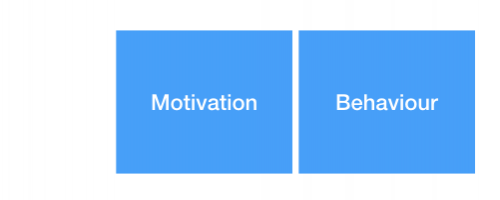
Typically (but not exclusively) the contact takes one of two forms: a human touch point or a mechanical/technical touch point, like a website, a check-in console or even an airplane seat. These are important moments that combined make up the full customer experience.

As I argued in my previous blog post, the human touch points have the highest potential to create the emotional connection that is crucial in our efforts to build loyalty, but they also carry the highest risk. If our human element does not deliver, it can be much worse than an automated experience. The mechanical touch point can generally be engineered to be emotionally neutral but rarely produces something that makes your heart sing. I recently checked in to one of these fully automated hotels. It was late, I was driving and just needed a bed for a few hours. All the automation worked, but I felt terribly lonely, with no human interaction whatsoever. There was nothing wrong with the product. But there was also nothing in that experience that would entice me to do it again or tell my friends (positively) about it.

The front line employee makes or breaks it

Our front line employee has the power to make or break the experience for our customer and if we want to make sure that our customer has the best possible experience, we need to make sure that our employee experience is the best possible. Sounds so evident, but that is not always what I observe out there.

So how do we design a great employee experience?

The starting point is behaviour.

When you think about your customer experience, your dream scenario is that your employee does ‘something’ that will make the customer feel appreciated, valued, looked after etc. This is why a lot of companies invest time and effort into training their staff to do certain things in a certain way and that is great. But it only takes us halfway to where we need to be. Because when our staff does things right, we only score 3-3,5 on a satisfaction scale of 1-5. The reason is that from a customer point of view, good is the expected level. You are not surprising them by being good, that is what they expect, and anyway most of your competitors are also ‘good’ otherwise they would not have even been in the game.

So in order to take the experience beyond the 3.5, we need to make an emotional connection. In practical terms, that means that the frontline staff need to invest a bit of themselves in the transaction. They will need to be flexible and adapt to each interaction and add to that interaction what they think would be meaningful to exactly this customer situation, be empathetic. It is not enough to say: ‘have a nice day’. That is not much better than the voice at the end of the escalator at the airport that says: Watch your step… watch your step… watch…

What drive positive service behaviours beyond just mechanically doing things right?

Motivation drives behaviour.

Motivation, engagement, mindset, call it what you like. But whatever you call it, let’s agree that it is some form of inner drive. The best service employee wants to do this. They enjoy being engaged and that is driven by how they feel. What influences how they feel?

The two primary drivers of how we feel on the job are: The culture that we are part of and the systems we are working with.

When we put all this together, we have the consultant’s favourite 2×2 matrix, but this one is a bit different because it is actually a very simple version of Ken Wilbers four quadrants in Integral Theory.

These four quadrants are interdependent. Change something in one and you affect the other three. If they become unbalanced in the sense that what is going on in one quadrant is not congruent with what we would like to see in another quadrant, then the ‘whole ‘ is not functioning optimally.

A simple example

A CEO called me to work with his group of middle managers. “They are not a team, they do not collaborate with each other and it is driving me nuts,” he said. “Can you please work with them and make that happen?”. So I asked him “What kind of remuneration system do they have?” Oh, he said, ” They get a handsome salary and they can earn a substantial individual bonus depending on how their department performs.”

Game over. As long as he maintains this ‘system’ of remuneration’, the ‘motivation’ for each of them is to do their best in they own department. There is no reason for them to collaborate. If he then further reinforces this by very strictly follow up on individual department performance, it just makes things even worse.

Understand the employee perspective through the 4 lenses

If you start analysing your service business using these four lenses, you very quickly start uncovering all sorts of things that are not congruent and therefore counter productive. The obvious ones are often in the ’System’ category. ‘Process’ or ways of working that are frustrating for front line employee but that nobody has done anything about. These we can often flesh out using Service Design tools like employee journey maps.

But the less obvious sources of disengagement come from the culture box and is typically related to what kind of psychological environment the supervisor and the supervisor’s boss is creating. As I have written about before here, culture beats strategy, always. We will take a closer look at that next week.


This spring we ran a series of blog posts around development, developing yourself and others. We have collected and edited those blog posts into a simple e-book that you can download below if you would like to explore this subject further.

Filed Under: General, GROW, Service Design Tagged With: employee, employee engagement, Employee experience, Frontline

  • « Go to Previous Page
  • Page 1
  • Interim pages omitted …
  • Page 7
  • Page 8
  • Page 9
  • Page 10
  • Page 11
  • Interim pages omitted …
  • Page 102
  • Go to Next Page »

Primary Sidebar

Search here

The Legal Stuff

Terms & Conditions

Privacy Policy

© Copyright 2025 Thoughts4Action cc - Privacy Policy - Terms & Conditions

All your work challenges are really relationship challenges

Get fresh perspectives and practical wisdom on building authentic professional relationships that make your life easier.

Join my newsletter list here (published once a month)