• Skip to main content
  • Skip to primary sidebar

Mike Hohnen

Coaching for personal growth, change and development

  • ABOUT
  • SERVICES
  • LIBRARY
  • COURSES
  • LOGIN
  • BLOG

Blog Page

Growing number of young female drinkers accros Europe

October 22, 2003By Mike Hohnen

One of the most significant changes in European drinking patterns in recent years has been the increase in women?s drinking, the report suggests. Young British women aged between 18 and 24 are by far the largest female consumers of alcoholic drinks in Europe, with annual per capita consumption of 203 litres in 2002 in the UK, compared to only 59 litres amongst young Italian women.

Despite France?s high spend on on-trade drinking, most of this cash clearly comes from men, with per capita consumption among young adult women just 70 litres a year, well below the European average of 104 litres. In fact, France is second only to Italy in the preponderance of male drinkers.

Young Dutch women consume around 107 litres of alcohol per year, while their Swedish counterparts drink 82 litres. German women are second only to the Brits, with annual per capita consumption of 189 litres. The average in the rest of Europe is 93 litres.

All these consumption levels are set to rise, however, with young British women expected to increase their input to 242 litres by 2007, Datamonitor predicts. Once again, however, Spain is likely to show the biggest increase, with consumption of alcoholic drinks increasing by almost 60 per cent between 2002 and 2007 to an annual 115 litres per young adult woman.

?This is partly because Spain is a less mature market and capable of rapid growth as young adult women become economically independent and societal attitudes to women drinking become less censorious,? Russell explained.

Other, more modest, rises are likely to come across the seven countries examined by the report, with German consumption among young women rising to 209 litres and Dutch input reaching 114 litres.

Sweden, France and Italy will still show a marked tendency towards male drinking, with young female consumption increasing to just 95, 78 and 75 litres respectively. [Read more…] about Growing number of young female drinkers accros Europe

Filed Under: Trends

trend toward upscale takeout and "fast-casual" dining

October 21, 2003By Mike Hohnen

The Loop’s lunch and dinner take-out business now accounts for 25 percent to 30 percent of its revenue, up sharply from the 5 percent to 10 percent it constituted 10 years ago.
        “Time is a commodity that two working parents and school-age children don’t have enough of,” said Schneider. “We’re talking about home-replacement meals. It elevates fast- food eating to dining. My generation grew up on fast food and grew out of it.”
        The National Restaurant Association reports that among restaurants with average checks of $25 or more, 70 percent offer carryout options. At the same time, the amount of time preparing meals at home continues to fall, according to an association survey in 2000. Nearly four in 10 adults said they were cooking fewer meals at home and 74 percent of adults said they found more restaurants to choose from than they had two years earlier.
        Outback Steakhouse, a national chain with 18 restaurants in North Florida and South Georgia, is taking advantage of the trend. It offers curbside service that lets customers call in their order and then drive to the restaurant where they park in a designated space to await the delivery of their food.

Filed Under: Trends

Cold sandwiches, salads and snacks at terminal gates

October 20, 2003By Mike Hohnen

The Dallas Morning News reports:

Dallas/Fort Worth International Airport is testing a program that allows its concessionaires to sell cold sandwiches, salads and snacks at terminal gates. It’s the first such experiment in the nation.

Au Bon Pain has opened a kiosk equipped with refrigerated cases at gate C19 in Terminal C, and TGI Friday’s has a similar operation at A18 in Terminal A. Corner Bakery will sell its fare out of a modified golf cart that will cover Terminal C between gates C27 and C35, depending on the flight schedule.

The three operations, which opened Oct. 7, are expected to serve 50 flights a day carrying about 5,000 passengers.

The test, which will last until January, is the latest example of how the aviation industry is trying to figure out how to get food to passengers without operating in-flight catering services.

D/FW also is hoping the program will boost its food and beverage revenue, which accounts for almost 10 percent of the airport’s total.

Sales of food, drinks, newspapers and gifts brought in $29.8 million in revenue during the fiscal year that ended Sept. 30, up almost 9 percent from the year before. But such revenue is still down more than 12 percent since before the Sept. 11 attacks.

Star Concessions spent $27,000 modifying a golf cart to house a refrigerator case for sandwiches and yogurt. It also carries snacks and hot coffee, all of which carry the Corner Bakery brand, owned by Dallas-based Brinker International Inc.

“We could probably do three or four of these carts just in Terminal C,” Mr. Aranza said. “They’ve been doing very well.”

Food items can be ordered as boxed meals, or a la carte. Prices range from 99 cents for a carton of milk to $10.50 for a box lunch including a sandwich, chips and a cookie. The cart and kiosks accept cash and credit cards.

Filed Under: Foodservice

Food for thought on how we build our relationships

October 19, 2003By Mike Hohnen

I picked this from the Herman Trend Alert Herman

—

Trend Alert: Building Relationships
October 15, 2003

Wal-Mart stores have a long-established tradition of greeting customers as
they walk in the door. The company typically hires senior citizens for this
important position, enjoying their maturity, dedication, and sincerity in
serving customers and representing the company. People shopping in Wal-Mart
Stores have an expectation that, if they have questions or concerns, there
will be someone right there at the front door to help them solve their
problems.

We’ve seen other retailers follow this same practice—from restaurants to
boutique shops to automobile dealers. No sales focus or other
responsibilities are involved; just a warm welcome. A number of employers,
particularly those with large facilities, employ greeters—to monitor
security as well as foster those valuable relationships.

Does this make sense? Will more employers assign people to serve as
greeters, to welcome customers and other visitors, answer questions, and
solve problems? Will these employees be solely focused on this role, or will
this responsibility be an additional task assumed by employees with other
duties? What difference will it make?

As technology fills an increasing role in consumer interaction, customers
will feel more separated from companies they do business with. This
depreciation of customer-supplier relationships will erode loyalty, putting
dependable revenue flow at risk. Wise employers will strengthen human-to-
human interaction to build loyalty and consumer satisfaction, particularly
at critical connection points like welcoming people and responding to
complaints. Whenever someone may be confused about how to interact with an
organization, opportunity for human contact will be especially valuable.

Union Regional Medical Center, Monroe, North Carolina, stations official
greeters in the lobby next to the reception desk. These greeters add an
extra welcome to what visitors already receive from the receptionists. They
answer questions, solve problems, and escort people to the correct
elevators, hospital services or facilities, or offices in the building.

Surprisingly, the people who perform this work, on a scheduled basis, are
hospital executives and mangers. Being helped by a high level executive
(yes, even the Chief Executive Officer participates) sends a clear message
to visitors and employees that treating guests (and patients) well is
essential. This is the future.

Filed Under: Marketing

Culinary kids unveil their wacky menus

October 18, 2003By Mike Hohnen

Children throughout the country have been coming up with some crazy culinary ideas to create a new dish for Spirit Group?s Wacky Warehouse menu.

Spirit has chosen 10 finalists from all over the country who have come up with the wackiest menu ideas.

Wacky Warehouse launched the hunt for budding chefs by asking children eating in their 120 outlets to name their perfect dish.

The 10 winners each won a meal for four at a Wacky Warehouse. One overall national winner will be chosen next month and will receive a trophy for creating Britain?s Wackiest Recipe.

The winning entries included bonkers bananas ? chocolate-coated bananas with ice cream cones for hats, and a jelly island volcano made from a mound of sponge and custard.

?We review the menu in our Wacky Warehouses to make sure the dishes are appealing to our children but also contain ingredients that are nutritionally sound,? said head of marketing Rory Carlin.

Source: The publican.com

Filed Under: Foodservice

Swiss inventors develop spaghetti plate

November 3, 2016By Mike Hohnen

The spaghetti plate looks similar to any other, except that it has a ‘crater’ in the middle, a little like an egg cup. Eaters use the hole to help wind the spaghetti around their forks.

Read the article

Filed Under: Trends

Quarter-size cabbages for Japanese singletons

October 16, 2003By Mike Hohnen

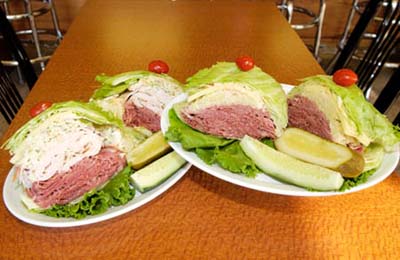
One of Japan’s leading supermarkets is to start stocking quarter-size cauliflowers and cabbages as part of a new dwarf vegetable range for single people.

Japanese retail giant Aeon said it had taken the decision to ramp up its mini- vegetable range after successful trials of half-size radishes.

“A growing number of people, especially in urban areas, live alone and they cannot consume large vegetables by themselves,” said company spokeswoman Naoko Ueda.

The mini versions of traditional vegetables have been developed by Switzerland’s biotechnology firm Syngenta Seeds, which prides itself on serving growers’ individual requirements.

Read the article

Filed Under: Trends

Tables turned on airline food

April 21, 2016By Mike Hohnen

Gourmet” sandwiches, brand-name snacks and decadent desserts are fast replacing mystery meat on U.S. airlines.

There’s one catch, though. You have to pay for it.

Read the article

Filed Under: Foodservice

  • « Go to Previous Page
  • Page 1
  • Interim pages omitted …
  • Page 97
  • Page 98
  • Page 99
  • Page 100
  • Page 101
  • Go to Next Page »

Primary Sidebar

Search here

Recent Posts

  • Is Your Organisation Just an Expensive Collection of Parts?
  • When Managers Check Out, Everything Downstream Dies
  • Why “nice” leaders lose their people
  • Measuring the Unmeasurable
  • The Authenticity Paradox: When Being Real Means Being Responsive
  • The Manager as Culture Weaver, Not Compliance Officer
  • The Future of Digital Relationships
  • The Relational Load of Modern Leadership
  • The Psychological Cost of Wide Span of Control
  • The Hidden Cost of Cutting Middle Management

All you challenges at work are in reality realtionship challenges

Get fresh perspectives and practical wisdom on building authentic professional relationships that make your life easier.

Join my newsletter list here (published once a month)

The Legal Stuff

Terms & Conditions

Privacy Policy

© Copyright 2025 Thoughts4Action cc - Privacy Policy - Terms & Conditions

All your work challenges are really relationship challenges

Get fresh perspectives and practical wisdom on building authentic professional relationships that make your life easier.

Join my newsletter list here (published once a month)