Every organisation I’ve ever worked with says it values honesty. Open door policies. Speak-up cultures. “We want to hear from you.” Town halls with anonymous question boxes. Feedback surveys with reassuring promises of confidentiality.
And yet.
Most people in most organisations have learned — not from the policy, but from the reaction — exactly what happens when you actually say what you think. It’s rarely dramatic. Nobody gets marched out. It’s subtler than that. It’s the slight pause before the response. The “thanks for raising that” that clearly means the opposite. The way your point gets acknowledged in the meeting and then absolutely nothing changes afterwards.
People are quick learners. They read the room long before they read the policy.
April’s issue explored why people stay silent — the real mechanics behind it. This month, I want to ask a different question: where does all that unsaid stuff actually go?
Because it doesn’t disappear.
The plumbing problem
Think of it like plumbing. An organisation’s formal channels — meetings, feedback processes, one-to-ones — are supposed to be the pipes through which truth flows. But when people learn those pipes aren’t safe, they don’t stop having things to say. The pressure doesn’t reduce. The truth just finds other routes.
It comes out as gossip. As the meeting-after-the-meeting. As passive-aggressive emails copied to one more person than necessary. As resistance to change that nobody can quite explain. As two departments locked in low-level conflict that has nothing to do with what they think they’re arguing about.
And here’s what’s interesting: most organisations treat every one of these as a separate problem. They see gossip and diagnose a “gossip culture.” They see passive aggression and book a communication skills workshop. They see the meeting-after-the-meeting and label certain people as “political.” They notice resistance to change and conclude that people just don’t like change.
But these aren’t separate problems. They’re the same problem, showing up in different places. They’re where truth comes out when it can’t come out where it should.
The underground economy
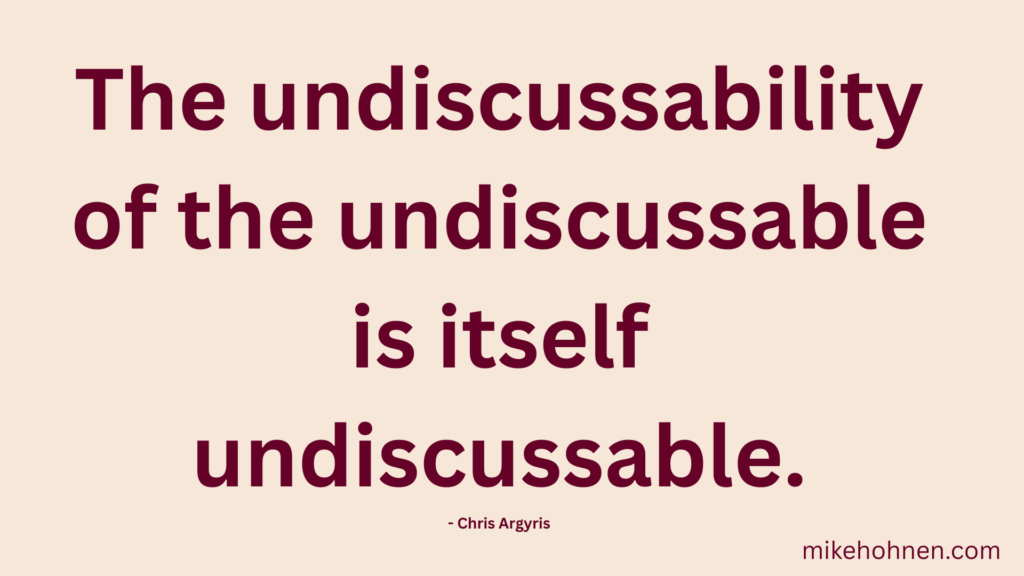
Chris Argyris, who spent decades studying how organisations actually communicate (as opposed to how they think they communicate), called these things “undiscussables” — the topics everyone knows about but nobody raises. And then he made an observation that still stops me in my tracks: the undiscussability of the undiscussable is itself undiscussable.
Read that again.
Organisations don’t just avoid the truth. They avoid talking about the fact that they avoid the truth. And they avoid talking about that too. Three layers of denial, each one reinforcing the others.
What you end up with is something like an underground economy. Truth becomes contraband — and like all contraband, it doesn’t disappear just because it’s been made illegitimate. It simply moves to a black market. There are dealers — the people who always seem to know what’s really going on. There’s currency — insider knowledge, traded carefully. And there are risks — being seen as negative, as not a team player, as disloyal.
This economy is running in every organisation, right now, underneath the official one. And it’s expensive. Not because the gossip itself causes damage, but because maintaining the gap between what’s said officially and what’s known unofficially takes enormous energy. Energy that could be going somewhere useful.
The real cost
Here’s what I think gets missed: most of what organisations diagnose as “culture problems” are actually the redirected output of truths that had nowhere legitimate to go. You’re not dealing with difficult people. You’re dealing with a system that turned honesty into contraband — and then wondering why a black market appeared.
The question isn’t how to stop the gossip, fix the politics, or overcome the resistance. The question is: what made the formal channels feel so unsafe that people built an entire alternative system to work around them?
That’s a harder question. But it’s the right one.
#WorkplaceCulture #PsychologicalSafety #LeadershipDevelopment