This is a great video clip of a young Steve Jobs in Action. Notic how he keep the team focused on what is truly important
Blog Page
Where to Play and How to Win…
Do you have a clear strategy ?
I have lost count of how many hotels and conference centers I’ve encountered over the years who define their strategy as ”delivering great customer experiences” or being ”among the top 5 in their category or region”.
But that’s not a strategy. At best it’s a vision and and worst-case it’s just wishful thinking
Strategy is distinctly different from visions missions and goals. Strategy crystallizes the very hard choices that we all need to make. Strategy defines how we create value. Value emerges when we have the skills to produce something that costs us less to produce than somebody else is willing to pay for it. Period.
Value = ( Sales Price – Cots to produce/deliver)
At first, that sounds simple – but it quickly gets trickier, what I may be happy to pay € 100 for is probably quite different from what you are happy to pay €100 for. Value is deeply subjective, each of us computes it in our own way depending on the circumstances and the situation.
It therefore makes no sense to talk about creating value without at the same time answering the question value for whom?
Because if I try to be everything to everybody I risk ending up being nothing to anybody and there’s not much value in that.
Where to Play
Developing an effective strategy therefore boils down to defining target market segments and clearly understanding what it is they need. (But but when targeting certain segments we also need to understand that that means there are other segments that we are willing to forgo)
How to Win
The better we understand the specifics of a segment the better we can tailor our service delivery in such a way that we produce value for exactly that segment.
So the 3 hard questions we need to ask our selves are:
1. Who is the target customer?
2. What is the value proposition to that customer?
3. What are the essential capabilities needed to deliver that value proposition?
Obviously, if we are running a hospitality business that is open 365 days a year we will need to identify several target segments ( time of year, day of the week – day part etc). Remembering, that what differentiates segments is not the demographics but the situation.
I have very different needs when I’m traveling in connection with a weekend break, compared to when I am traveling to conduct a workshop – same fellow very different needs ( and price points).
So we need to break down our value propositions into situations.
In my book Best! . No need to be cheap if you are … I have a chapter on how to work on you value proposition using the value equation.
Also here is a great article from S+B on the same subject – and finally the best tool to visualize and brainstorm some more on this is the Business Model Canvas as explained in the video here.
Why write a book…
We live in a world of abundance which basically means that there is too much of everything. Supply outstrips demand in virtually any business category you can imaging. This hyper competitive situation forces us all rethink our approach if we want to be successful.
This is the core idea of my new book.
So why write another book you might ask – it’s not as if the world is craving for more books on service, customer focus or management?
Surely there is also an abundance of books?
Well – Yes… But on the other hand… No!
Let me explain.
My work in the service industry has been based on the principles outlined in a book that caught my attention in 1990 called The Service Profit Chain – shortly after the book was published I became the CEO of a large hospitality group and the principles outlined in the book became the basic foundation for the approach that we took. It worked like a dream for us.
In fact it worked so well that in 2001 I decided to form a consulting and training company that would help others implement the principles of the Service Profit Chain.
So for the past 10 years or so I have been delivering workshops, training, and keynote speaking to companies in the service industry from consulting engineers to managers in large hospitality groups.
I nearly always get asked at some point: ”Where can we read more about this? ”
And I refer people back to the original work published by Harvard in 1989.
But when I then check back later and ask if they enjoyed the book I very often get slightly sheepish looks and some mumbled excuses about not really getting past the first chapter.
I suspect this has to do with the fact that a lot of the people working in the service industry prefer a very practical hands-on approach to their learning. The original service profit chain book is a fabulous piece of work but it is in parts quite theoretical and with more than 360 pages to get through it is also quite a mouthful when you have a lot of other stuff on your plate.
Invariably the discussion therefore leads the obvious question from my client: Why don’t you write an easy to read, simple to understand hands-on guide to implementing the service profit chain – we really need that!
And funnily enough when I then researched what’s already published I can’t find anything that integrates all seven steps of The Service Profit Chain into one coherent system that is easily understandable at all levels of the organisation.
So there was nothing els for it but do it my self – and here is is:
Best! No need to be cheap if you are…
Flash sales – good or bad idea?
Together with spa/beauty, travel /travel tourism and restaurants are the top 3 categories both in the number of deals and amount of revenue generated by flash sales.
Discounting is clearly increasingly popular. Customers love it and more and more companies are piling in to catch a bit of the action. Nonetheless Groupon and LivingSocial are still by far the 2 largest players.
But is it good business in the hospitality sector?
I think that question is the most frequently debated subject amongst industry players wherever they gather at the moment.
On the surface there are 2 fronts.
Those that are doing it and therefore have all sorts of sophisticated arguments why they consider it good business. On the other side those that are not doing it because they consider it the worst form of business ever.
What until now has been really hard to evaluate is who is right and who is wrong.
But now the Centre for Hospitality Research at Cornell University has just released a study that tries to answer exactly that question and a few more – this most useful report can be downloaded here
Key findings are:
Generally participating hotels surveyed report moderate success.
The deals do bring in new business. But as to producing repeat business this is too much less extent the case than what hoteliers hope for when arguing for using these promotions.
“One factor often cited to justify offering a flash sale pro- motion, repeat business, did not seem to operate for these respondents.”
Hoteliers who are happiest with the outcome of their deals are also the ones who have managed the total cost of the deal most assertively.
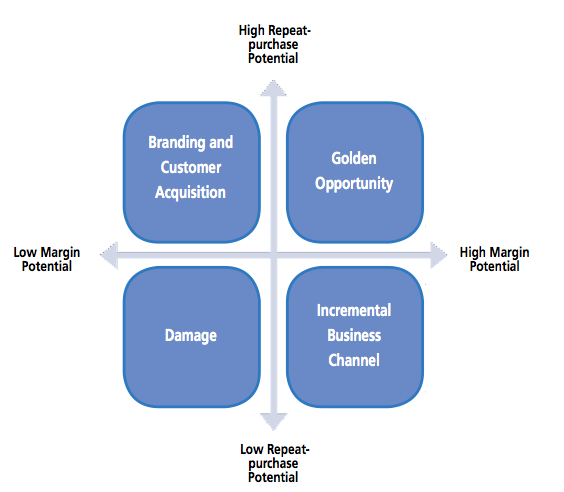
Overall the conclusion seems to be that flash deals can work for you if you are very astute in negotiating the deal with the coupon provider and you find a way to either upsell to these customers when they are there or have a surefire way to convert them into repeat customers.
This is very neatly illustrated by the authors like this
“Evaluating your property on these two dimensions allows you to better frame the value proposition offered by flash deals. If you don’t expect to be able to convert customers from flash sales deals into returning guests, you must carefully manage the margins of any deal you develop and creatively identify opportunities for cross-selling and up-selling once guests are on property. When you expect high conversions from flash sales customers to returning guests, you could justify the deal as a marketing expense. You should carefully avoid structuring any flash sales that will land you in the lower left quadrant.”
Emerging Marketing Channels in Hospitality:
A Global Study of Internet-Enabled Flash Sales and Private Sales
by Gabriele Piccoli and Chekitan S. Dev – you will find it here
Question:
What are your experiences with Flash sales – are they working/not working for you?
Don’t wait for your ‘KODAK moment’
The best advice from Seth Godin... ever in my opinion:
“The new thing is never as good as the old thing, at least right now.
Soon, the new thing will be better than the old thing will be. But if you wait until then, it’s going to be too late. Feel free to wax nostalgic about the old thing, but don’t fool yourself into believing it’s going to be here forever. It won’t.”
If you don’t understand this you will have a “KODAK – Moment” and wake up one morning and find that the new thing that was not nearly as good as your old thing has now stolen your business.
Goals : Hubris or doubt what works best?
A dash of honest doubt turns out to be not so bad after all.
The coaching gurus all seem to agree. To reach your goal you need to declare it and abracadabra you are already halfway there.
Well, it turns out that they could be wrong.
According to research performed by a group of American scientists last year and document by Daniel Pink there is a significant difference in performance between 2 groups performing the same task and where one group uses what the scientists called declarative self talk ( I can do it) and the other group uses interrogative self talk (Can I do it?).
The self questioning group performs a lot better than the self affirming group.
In Denmark we had an interesting example of this recently.
As the Danish handball team departed for the European Championships they self confidently declared that they were going for gold. They subsequently lost their first few games and in no way looked as if they were going to get anywhere near the finals. The fans at home of course were furious and the players and trainer were all accused of hubris. Subsequently the declarations from the trainer and players took a subtle shift from ”we can do it” to some serious self questioning around ”can we do it?” and ”what would it take to do it?” – and – abracadabra, they brought home the gold medals to everybody’s surprise – including their own I guess.
The research seems to indicate that people who ask questions somehow come from a more humble place and that in turn creates a space to come up with a deeper solution.
For those of us who have been working with action learning for years that does not come as a big surprise….
Implementing the Service Profit Chain
My new book has now been published !

Inspired by the principles developed in the “Service Profit Chain”, Mike Hohnen takes you through each of the steps needed to create an outstanding service business.
You will find it here on Amazon
Best!
We live in a world of abundance – there is plenty of choice everywhere. And since 2008 we have experienced significant drops in demand as consumers became more careful. The result is a widening gap between supply and demand in virtually any category you can imagine.
When that happens, many companies have a knee-jerk reaction, and the recipe is more or less always the same: initiate rigorous cost-cutting programs, reduce staff and/or services, offer discounts in many forms, and increase advertising aggressively.
This, however, is the equivalent of trying to steer and brake as your car begins to skid on black ice while going through a sharp curve.
As you hit that declining demand curve, you need to perform what at first seems like a counterintuitive move: hold your price, increase your services, improve your quality, and narrow your focus in the market.
In this book, you will not only understand why but also see how you can do that.