• Skip to main content
  • Skip to primary sidebar

Mike Hohnen

Coaching for personal growth, change and development

  • ABOUT
  • SERVICES
  • LIBRARY
  • COURSES
  • LOGIN
  • BLOG

General

Teams are organic systems, and therefore, by definition unstable.

December 27, 2016By Mike Hohnen

Team member

As we continue to explore team leadership as different from team management, we now need to look at another aspect of the team.

A team is also a system. And when we look at it from that angle, we need to recognise that systems come in many forms. One way to look at them is as either mechanical or organic. Mechanical systems are things like computers, cars and factories. Mechanical systems are by definition stable. You may feel that your car is moody – but that is probably more about you than the car. The car works or it does not work. If you stress it, it continues to work up to a point and then it snaps and is kaput.

Human beings – the core elements of your team are organic systems, as are cats, cauliflower or caterpillars. And organic systems are by definition unstable. They are always in transition from one state to another. Humans, go from happy to excited to sad. From wide awake to drowsy. From enthusiastic to reluctant and back again, on and on it goes. The only constant is change.

If we try and handle this instability with just management tools, we quickly get into trouble. The whole principle of management is that we can set up rules, and ways of doing things that can be replicated every day no matter what. Great idea if you are working with a stable system – quite tricky if you are working with an unstable system. Add to that, the complexity that these team members are not transitioning from one stage to another in an orderly and synchronised manner. While A is happy, B is frustrated, and C is indifferent. And tomorrow that may well be the other way round. It just depends…

The instability is not completely random. We typically shift to a new state as a result of some stimulus. This can be a change in weather, a remark from a colleague, a difficult task etc. the list is endless. Here you see the big difference with mechanical systems. Your car does not get sad when it rains, happy when we are going downhill – or frustrated by all the bigger cars on the road today. It just does its car thing in the same state no matter what.

Now all this may seem obvious to you. But in my day to day work as a coach, I keep running in to leaders who are assuming that everyone on their team is operating like a car and therefore have two states ‘off’ and ‘on’.

First step is to acknowledge and accept that this is what is going on. Learn to live with the fact that everyone around you is basically unstable – including you.

Second, if you are the kind of leader who is highly volatile or moody or otherwise prone to dramatic shifts in your states, you need to learn to manage your own states (I will be giving an online course on that in beginning of the New Year).

Thirdly, now that you are aware that this is what is going on, you need to help your team members better manage their states.

We will look at that in next week’s post.

team-leaders-toolbox2Enter your email address below and we will notify you when we launch the Team Leader’s Toolbox!

_______________________________________________________

This post is one of a series where we are exploring the notion of leadership and how this is different from management. Our starting point is the Service Profit Chain and the understating that the management part of our job will only take us so far. If we really want to create an organisation that is capable of delivering outstanding customer experiences, we need to develop an organisation that delivers outstanding employee experiences – and that requires leadership. You can check out other articles of the series below:

  1. Are you an inspiring leader to work for?
  2. What does it require to be an inspirational leader?
  3. The something for something system is at the heart of the uninspiring workplace.
  4. How is team management different from team leadership and why should I worry?

Filed Under: General, Leadership, Leadership/Management, Learning, Training & Development Tagged With: first-time manager, Leadership, service, Service Profit Chain, Team, Team Leadership, team performance

How is team management different from team leadership and why should I worry?

December 27, 2016By Mike Hohnen

12984010 - leader versus manager

When it comes to leadership, there seems to be three major and very common challenges.

How to best:

  • Provide inspiration
  • Lead a team
  • Develop employee capacity

During the month of October, we explored what it means to be inspirational. This month, we will explore what leadership means in a team context. December will then be dedicated to the challenge of developing employees.

Just to recap. The basic premise for this series of articles is that management and leadership are distinctly different. Both are required, but somehow we tend to focus much more on the management part of the job and tend to neglect the leadership aspect (read more about this here ). If you are in the service industry, it will ultimately affect your guest experience.

In my view, team management is all about the operational practical and very tangible aspects of what the team does. Tasks, timelines, delivery, budget and all that stuff. It all needs to be looked after or else we really get into trouble.

But good management will only get us halfway or at best two-thirds of the way to what high performance would look like.

What is a team?

Have you ever thought about what it takes for a group of people working together to transition into becoming a team?

It takes two things.

There needs to be a common goal and there needs to be a mutual responsibility for reaching that goal.

It is not enough that I do my part on the team. I must also be concerned how you are doing and if you are struggling I must do whatever I can to ensure that you are also successful with your part of the job. That is teamwork.

It’s this last part that is tricky. It is relatively easy to establish a common goal – but establishing mutual responsibility is much much harder.

In order for that to happen we need DAC – direction alignment and commitment – this is a neat concept or way of thinking about leadership developed by the Center for Creative Leadership. I have written about this before here.

Here is a simple way to evaluate if all three of these elements are happening on your team:

Happening Not Happening
Direction – There is a clear vision of a desired future that everyone buys into.
– Team members are individually clear on what the team is trying to achieve as a whole.
– No agreement on priorities
– Team members feel they are bingo pulled in multiple directions.
– There is lots of activity but not much progress.
Alignment – Roles and goals are clear individually.
– There is a clear understanding of how each and everyone contributes to the larger picture.
– There is a sense that this is a well coordinated and synchronised effort.
– Deadlines are missed. Rework required and lots of errors resulting in double work.
– People feel disconnected from each other.
– Internal competition and blame games are the norm.
Commitment – Team members go the extra mile.
– There is a sense of mutual understating and trust.
– There are visibly high levels of engagement.
– Only the easy things get done.
– Team members are questioning what is in it for them.
– Individuals avoid taking ownership and responsibility.

If it is not happening, the obvious question is what do you need to do to make it happen? Because it’s not a management ‘thing’ – you can’t create an excel sheet or 10 point checklist – nor can you ‘tell’ them that this is what needs to happen.

What you can do, however is provide a space where they can co-create this with you. And that requires leadership.

I will come back to what you can do later in this series. Early 2017, we will launch an online training module that will show you a basic hands on approach of how to do it.

Next week, we will look at another aspect of why your team needs leadership. This has to with the instability of organic systems.

team-leader-toolbox-1Enter your email address below and we will notify you when we launch the Team Leader’s Toolbox!

___________________________________________________________

This post is one of a series where we are exploring the notion of leadership and how this is different from management. Our starting point is the Service Profit Chain and the understating that the management part of our job will only take us so far. If we really want to create an organisation that is capable of delivering outstanding customer experiences, we need to develop an organisation that delivers outstanding employee experiences – and that requires leadership. You can check out other articles of the series below:

  1. Are you an inspiring leader to work for?
  2. What does it require to be an inspirational leader?
  3. The something for something system is at the heart of the uninspiring workplace.

Filed Under: General Tagged With: Employee loyalty, engagement, first-time manager, Inspirational, Leadership, service, Service Profit Chain

The something for something system is at the heart of the uninspiring workplace.

October 29, 2016By Mike Hohnen

Unspiring

The Something-For-Something System is what happens in most organizations today.

Here is how it works. You come into work and give some of your time in return for a salary. If you work a bit harder, or a little bit more, or a little bit better, you have an expectation that you will also be rewarded for it — a bonus, overtime pay, a promotion, or whatever.

If you don’t work so hard or don’t do your job very well, it is built into the model that you can expect some kind of ‘punishment’.

The assumption is that you come to work because it is in your own interest. You need the money so you can pay your rent, feed the kids, or play golf during the weekend. It’s a something-for-something kind of thinking which has thousands of years behind it. Technically, it is known as transactional leadership.

The Game We Play

If the employer and the employee, or in practical terms, the manager and the employee, have a relationship which basically is about something-for-something, then it very easily becomes a game where you, as an employee, try to get away with doing as little as possible while at the same time getting the maximum amount out.

In that perspective, you could say that from the employee’s perspective, you have actually won something if you managed to do a little bit less and still get paid the same for it. That would be a win for you.

The manager’s role in an organization that practices transactional leadership is not very exiting either, because what this means is that the manager’s most important role is to control whether or not the organization is actually getting the output that the organization is paying for. That means time-stamping, control sheets, registration, serious conversations, the possibility of written warnings, and eventually, the ultimate punishment – layoffs.

In a transactional world, an effective manager is a person who distributes reward and punishment in such a way that he maximizes the output of the employee.

It’s all about management and there is no time for real leadership.

Management by Exception

In a transactional world, the manager manages by exception. By that, I mean that the manager is actually only exercising their management role when something is not working according to the plan, not living up to the expectations. Only when somebody’s not doing what they’re supposed to be doing, they put on their managers cap and do something… maybe.

Maybe, because as most of us don’t actually enjoy being bossy. As a result, the management role easily turns into non-management – something I only do if I absolutely must.

If things are going sort of reasonably OK, then there’s no real reason to do much, is there? It becomes a sort of ‘let sleeping dogs lie’ atmosphere. And in the organizations that are really bad, the supervisor, who is supposed to manage his front-line, gets this same treatment from his department head, who gets exactly the same laissez-faire management from the division VP or whatever. The something-for-something culture runs all the way through the system.

Unfortunately, a lot of research shows that this leadership style is neither inspiring nor the most productive. It’s not something that creates an extraordinary organization or fantastically enthusiastic and loyal customers.

It produces something that is often okay, but rarely fantastic.

It’s built into the model that it has to be like that; it is all that can happen as long as we have that mindset.

Now, I hope you are beginning to see what the problem is.

As long as we understand the world from a transactional paradigm, the something-for-something mindset, we aren’t going to get any further. We are stuck.

So, what is it going to take?

Well, as Frederic Laloux says, we need to move into a completely different mindset. We need to change our paradigm. We need to switch from transactional leadership to transformational leadership.

___________________________________________________

This post is one of a series where we are exploring the notion of leadership and how this is different from management. Our starting point is the Service Profit Chain and the understating that the management part of our job will only take us so far. If we really want to create an organisation that is capable of delivering outstanding customer experiences, we need to develop an organisation that delivers outstanding employee experiences – and that requires leadership. You can check out other articles of the series below:

  1. Are you an inspiring leader to work for?
  2. What does it require to be an inspirational leader?

Filed Under: General Tagged With: customer experience, Employee loyalty, Inspirational, Leadership, service, Service Profit Chain, Transformational leadership

What does it require to be an inspirational leader?

April 13, 2022By Mike Hohnen

54852959 - meeting discussion talking sharing ideas concept

The concept of being inspirational may feel overwhelming to some. We tend to associate inspirational with icons of business like Richard Branson or monumental politicians such as Churchill or Kennedy.

But if you did the little exercise I invited you to try out last week, trying to identify leaders who in your career have been inspirational. I am sure you came up with a few even if you have not been fortunate enough to work for someone in the Branson category. Leaders with a lot less punch than Branson can still come across as very inspirational.

So, is the ability to be inspirational something we are born with or is it a learned skill? Maybe a bit of both. It is probably true that for some people, this comes more naturally than to others. But there is also lots of evidence that becoming more inspirational can be learned.

It begins with awareness. Awareness precedes change.

If we can identify the gap between our current skill level and the results we would like to see, then we have the best possible starting point for learning.

So, looking at what it takes to become inspirational, we can start with the very basics. Two things need to be in place for you to come across as inspirational and followership to occur as a consequence.

1) You need to be there.
2) You need to know where you want to go.

Yes, the first step is presence.

Only if you are fully present can you hope to be an inspiration to anybody. If you are distant, unfocused, distracted, frustrated or otherwise multitasking. You not only don’t have the necessary connection with the people, you are also undermining whatever trust there was between you.

No trust, no followership. David Maister has written extensively on how we compute trust in others. You can find more here.

What now?

Try and observe yourself over the next few days as you interact with your team. At the end of the day, rewind the day and think about the encounters you had. Were you fully present? Yes or no? Presence is a bit like pregnancy in that you cannot be somewhat present. Either you are there or you are not.

If you can identify situations when you were not fully there, ask yourself why. Was it your mood, external interference or what? Did you forget to reset you mind and body as you drifted from one meeting to the next? Was half of you still arguing a point in the previous meeting as you started the new one? If you are unsure how to reset your body/mind to a more present state, check out my friend Anouk Brack. She and her colleagues do a great job teaching this stuff.

Once you have mastered being present – it’s time to get clear about where are you going. Sometimes we call that vision/ mission work, but again that can become awfully theoretical and highbrow. I like to ask myself the question: So what are we trying to create?

Think of yourself having a coaching conversation with me. What would you answer be if I asked you: So if we were having this conversation one year from now and you were to look back on the past 12 months, what would have happened in your (department, company, team) for you to feel that you had made some real progress?

If you can answer that, gather your team and have a conversation about how they feel about this and what they think it is going to take from all of you to get here.

Now you have taken a first important step to becoming much more of an inspiration to your followers.  At the same time, this is also a first step to creating the Dream Team that is the foundation of implementing the Service Profit Chain.

Let me know how it works or if you have any questions.

And if you have not yet downloaded my e-book on engagement, you might find some ideas in that to swell. You will find it HERE.

Yes ! Send me the EbookEnter your email address below and download the ebook now!

 ___________________________________________________

This post is one of a series where we are exploring the notion of leadership and how this is different from management. Our starting point is the Service Profit Chain and the understating that the management part of our job will only take us so far. If we really want to create an organisation that is capable of delivering outstanding customer experiences, we need to develop an organisation that delivers outstanding employee experiences – and that requires leadership. You can check out other articles of the series below:

  1. Are you an inspiring leader to work for?

Filed Under: General Tagged With: engagement, first-time manager, Inspirational, Leadership, Service Profit Chain

Are you an inspiring leader to work for?

December 27, 2016By Mike Hohnen

As I promised last week, this is the first in a very practical series of blog posts focusing on practical aspects of leadership: Why is it important? What does it mean and how can you do it?

If you did not read last week’s post, you might want to read that first – you will find it here.

I have over time become aware that many of you find that the management part of your job is pretty clear and relatively straight forward but as for the leadership aspect, it sometimes feels fluffy.

So let’s take the fluffiness out of leadership and make it very practical and hands on.

Over the next month, we are going to cover three main leadership themes: Inspiring others, Leading my team and Developing my people.

So starting with inspiration, we need to understand why being an inspiration to your followers is an all important part of your leadership skills.

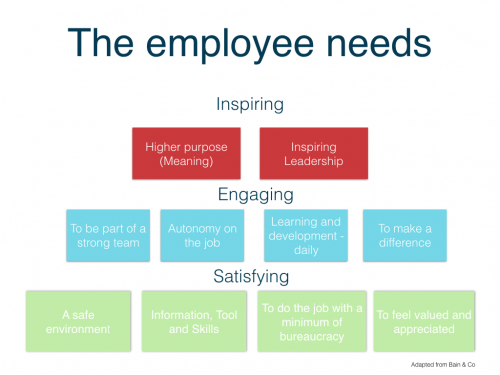
Below is a graph that illustrates how the hierarchy of employee’s needs looks.


lEmployee needs pyramid

At the bottom, we have the foundational stuff. Without that being in place, we don’t even get basic satisfaction. This is more or less all basic management stuff that you are probably (hopefully) already doing. The next level, on the other hand, is where your leadership skills start to make a difference and what drives engagement. Finally, we have the top layer – Inspiration which is driven by the style of leadership you are providing.

There are, as you can see on the graphic, two aspects to Inspiration. There is the Vision/Mission for your company, department or whatever. That should answer the question: Are we trying to achieve something that is meaningful? And secondly it is about you. Are you the sort of person that inspires followership?

So why is this important?

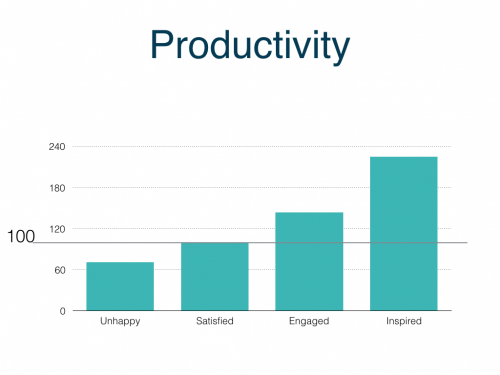
Well if you are the sort of persona that likes the fluffy soft to be backed up by hard facts then take a look at the graph below.

Inspiration drives productivity

At the end of the day, this is about productivity. People who are inspired produce twice as much as people who are just satisfied with their job. If you check out the Gallup engagement scores, you will see that around 63% of employees are not particularly engaged in the job. So from a leadership point of view, there is plenty of room for improvement in most places.

This is a pet subject of mine as you may have noticed. When we are talking Service Profit Chain implementation, employee satisfaction as such is not particularly interesting. What counts at the end of the day is enthusiasm and engagement.

But productivity is just one aspect of why being inspirational.  The other aspect is linked to rapidly changing demographics – all the indicators are clear, within a few years we are going to be scrambling to find the employees we need.

In Northern Europe especially, the stats are clear. Soon we will see that for every four people that leave the industry (pension, age etc), only one new young person signs up. That is a disaster waiting to happen.

So you basically have two choices. Try and automate like crazy – but that does not provide especially breathtaking service experiences, nor are they easy to differentiate from the other offerings out there. Or you can choose to create a place to work that stands head and shoulders above everyone else in your region and therefore become the employer of first choice. Too bad for the rest but you will do fine.

So hopefully you now see my point – focusing on what it will take to provide an inspirational environment for your people is a strategic issue and you need to get better at it than your closet competitor. Or if you look at it from a career point of view, managers who understand how to do this are going to be in high demand.

So what does it take to become inspirational? That is the theme for next week’s blog post.

In the mean time, I would like you to reflect a bit on what bosses you have had in your career that you found inspirational and what was it they did? And of course, the opposite. Who were the absolute joy killers and what was it they did that would instantly makes us feel disengaged and lethargic?

Dream Team____________________________________________________________

This post is one of a series where we are exploring the notion of leadership and how this is different from management. Our starting point is the Service Profit Chain and the understating that the management part of our job will only take us so far. If we really want to create an organisation that is capable of delivering outstanding customer experiences, we need to develop an organisation that delivers outstanding employee experiences – and that requires leadership.

Filed Under: General Tagged With: Employee loyalty, engagement, Leadership, service, Service Profit Chain

Enthusiasm is a function of your leadership.

April 14, 2022By Mike Hohnen

Helping organisations implement the Service Profit Chain is what I do and have done for the past 17 years. So over time, I notice that certain patterns repeat themselves.

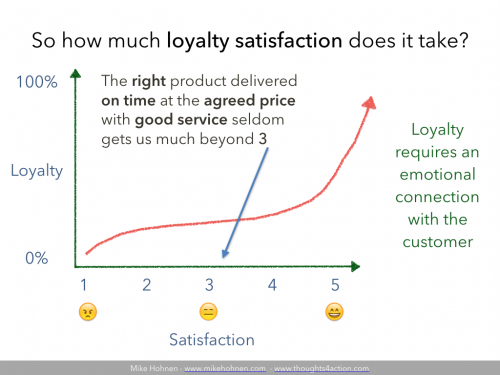
The basic premise of the Service Profit Chain is that the key to profit and growth is to cultivate customer loyalty. Customer loyalty occurs when guests are very satisfied. So invariably the question is: How satisfied do our customers need to be before the loyalty effect starts kicking in?

It varies a bit depending on a number of factors but for now, let’s just use the ultra simple way of looking at it.

Service Profit Chain - employee loyalty

The research is pretty clear.

Basic satisfaction does not create loyalty. What we are really looking for is customer enthusiasm. The challenge, however, is that when we get it right. When we deliver exactly the right ‘product’ at the right price on time and in the quality that was agreed, we only get to 3 or 3.5 in satisfaction. And it does not get us anywhere near generating any form of loyalty.

So doing it right is just the first step. To that we need to add the emotional component. When our frontline staff makes an emotional connection with the guest, loyalty is generated.

Now, we cannot put a clause in the employment contract with our frontline staff that they must develop emotional connections. It does not work that way. We and our staff create emotional connections, go the extra mile, display empathy, etc. when we feel like it.

So who on our team can do this?

blog-post-leadership-management-002

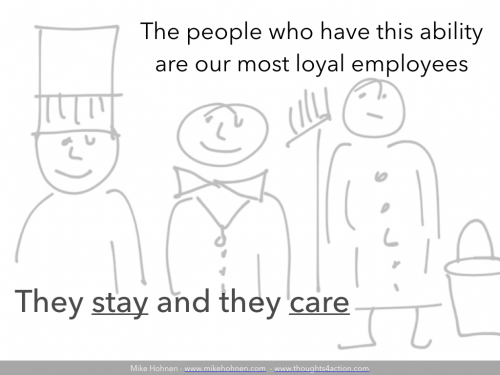
Our most loyal and engaged employees do this. They do it because they feel like it, not because they are told to do it.

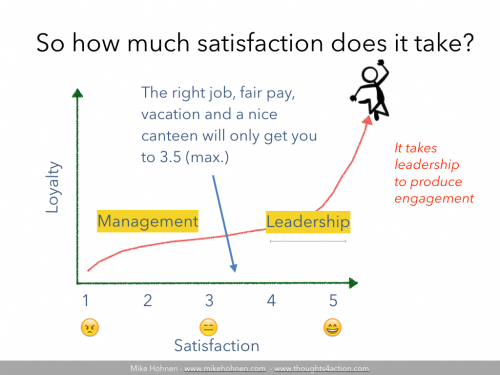
And fundamentally, they do it because they enjoy their job. Loyalty and engagement is a consequence of high levels of satisfaction. The obvious question then is how satisfied do they need to be in order for loyalty and engagement to occur?

blog-post-leadership-management-003

Again the challenge is that when we provide a good job, at fair wages, breaks, vacation and a nice canteen. Then we only achieve a level of satisfaction of 3 or 3.5 at the best. Well organised and structured jobs provide the baseline. If we want more, we need to provide what is essential to an emotional connection. They need to ‘feel’ enthusiastic about their job, the people they work with, and the company they work for.

Simple to describe, not so easy to do.

The issue in a nut shell, seen from my point of view having now worked with hundreds of managers in service organisations, is that their main focus is on the management part of their job. This is what gets measured especially short term and this is more tangible in the form of check lists, planning, controlling etc.

It is also what stands out very clearly when it is not done. Not doing the management part of your job quickly gets you into trouble – so we do that first.

When it comes to the leadership component, two obstacles are common.

There is a time issue and there is lack of understanding about what leadership means in practical day to day things they must do. They often understand the need but many of them don’t actually know what it means in practical behaviour terms. What must I actually do?

So when time is scarce and you are unsure what it is you should be doing, the result is simple: It does not get done.

And the end result is what you can read loud and clear in the yearly Gallup engagement surveys, that year after year show us that around 60+ % of the workforce are not particularly engaged in their job. What a waste.

For the next few weeks I have therefore decided I would like to focus on the leadership component. To try and demystify it and translate what may seem fluffy to some people into practical steps that can relatively easily be integrated into your busy day.

If you would like to brush up on the principles of the Service Profit Chain, we have a free e-learning module that you can take it HERE.

______________________________________________________

This post is one of a series where we are exploring the notion of leadership and how this is different from management. Our starting point is the Service Profit Chain and the understating that the management part of our job will only take us so far. If we really want to create an organisation that is capable of delivering outstanding customer experiences, we need to develop an organisation that delivers outstanding employee experiences – and that requires leadership.

Filed Under: General

What is your declaration of incompetence?

December 27, 2016By Mike Hohnen

Learning

Learning and development is a key component in our overall wellbeing.

In order for you to learn – there needs to be a gap: A gap between your desired results/performance and your current ability. This was the topic of last week’s post where you can find a more detailed explanation.

You may of course not be getting the results you hoped for despite the fact that you have the ability. I.e. you know what to do but you are not doing it. That is not a learning challenge but a motivational challenge – the cure for that could be a bit of coaching but that is topic for another day.

We can look at our roles from two perspectives. There is a management perspective and a leadership perspective. Identifying the gap from a management perspective is often quite easy. In our roles as managers, there are typically some quite explicit expectations that have measurable metrics attached to them.

But the other part of our job – the leadership aspect does not come with the same set of quantifiable metrics. So how can we identify the gaps here?

One way of doing it is to use the DAC framework developed by Center for Creative Leadership. I wrote about that in a previous post that you will find here.

So to what extent do you feel that there is direction, alignment and commitment on the team that you are leading?

Take look at the matrix below and ask you self that hard questions on each of these. Where is my team and where would I like them to be?

Happening Not Happening
Direction – There is a clear vision of a desired future that everyone buys into.
– Team members are individually clear on what the team is trying to achieve as a whole.
– No agreement on priorities
– Team members feel they are bingo pulled in multiple directions.
– There is lots of activity but not much progress.
Alignment – Roles and goals are clear individually.
– There is a clear understanding of how each and everyone contributes to the larger picture.
– There is a sense that this is a well coordinated and synchronised effort.
– Deadlines are missed. Rework required and lots of errors resulting in double work.
– People feel disconnected from each other.
– Internal competition and blame games are the norm.
Commitment – Team members go the extra mile.
– There is a sense of mutual understating and trust.
– There are visibly high levels of engagement.
– Only the easy things get done.
– Team members are questioning what is in it for them.
– Individuals avoid taking ownership and responsibility.

Is there a gap?

So back to the learning – for learning to happen you must declare your incompetence. “I would like to achieve xyz but actually I don’t quite know how to get there.”

How does that feel? Scary, intriguing, motivating? Whatever you are feeling, what is important is that you are slightly out of your comfort zone – because that is where learning, growth and development actually take place. So if it feels a bit uncomfortable – great, you are on track.
There is a great learning opportunity.

______________________________________________________________

If you have the curiosity to take a deeper dive into the subject of how we produce engagement on our teams, you are welcome to download my ebook Understanding Engagement.

Enter your email below and download the ebook now!

In this brief e-book, we will look at how the lack of engagement is to a large extent a function of leadership. And that if we really want to change the engagement levels on our teams, we will need to make radical shift in how we understand the world of work. The shift is all about moving from a transactional mindset to a transformational mindset. We will look into what that means, how it can help you as a manager and why it is so important.

Yes ! Send me the Ebook


Filed Under: General, GROW, Leadership, Leadership/Management, Learning, Service Profit Chain, Training & Development

What is the gap between your capability and your desired results?

December 27, 2016By Mike Hohnen

Capability Result gap

The research is pretty clear – personal growth and development are key factors in creating engagement on the job.

If we are lucky, we have a job situation where continuous learning and development is built into the culture. But in my experience, this is definitely not always the case.

So if no one else is looking out for your growth and development then maybe you should take it into your own hands – if not you, who else?

In order for us to develop and grow as human beings – and managers – some forms of learning probably need to take place.

But what does it mean to learn?

One definition that I like is this one:

“To learn is to increase your capacity to accomplish the results that you desire.”

Think about that for a moment.

What does it take for us to learn then?

For learning actually to happen, there must be a gap between your current capability and the results that you desire.

This makes it all a bit trickier. Because that means that in order for learning to actually take place, you will need to:

  • have an awareness of the the gap
  • be willing to declare your incompetence (at least to yourself)
  • commit to learning

So your first step here is to start the search for appropriate gaps between current capability and desired performance.

There are several ways to start thinking about this. But let’s start with the very big picture – and draw a 2×2 matrix.

On one axis, we have you as an individual versus the organisation; On the other, we have the internal vs the external perspective.

learning

This then gives us four large areas to choose from:

1) My internal drive, attitudes and motivation. How I choose to see and understand the world – This will, to a very large extent, determine how the world responds to me.

2) How I relate and connect to people around me – Strong interpersonal dynamic is a key to succeeding in any kind of managerial role.

3) My knowledge of an ability to shape the culture that I am part of – Culture eats strategy for breakfast remember.

4) My understating of an ability to influence the myriad of external stakeholders , customers, supplier, partners etc.

So take a moment now to reflect.

On a scale of 1 to 10, how satisfied are you with your achievements in each of these four overall areas? Where do you see a gap between your current capability and the results that you desire?

I leave you with these thoughts for now – next week, we will continue our exploration of how we can take responsibility for our own growth and development.

___________________________________________

If you have the curiosity to take a deeper dive into the subject of how we produce engagement on our teams, you are welcome to download my ebook Understanding Engagement.

Enter your email below and download the ebook now!

In this brief e-book, we will look at how the lack of engagement is to a large extent a function of leadership. And that if we really want to change the engagement levels on our teams, we will need to make radical shift in how we understand the world of work. The shift is all about moving from a transactional mindset to a transformational mindset. We will look into what that means, how it can help you as a manager and why it is so important.

Yes ! Send me the Ebook

Filed Under: General, Training & Development Tagged With: Action Learning, Change, engagement, GROW, Learning

  • « Go to Previous Page
  • Page 1
  • Interim pages omitted …
  • Page 12
  • Page 13
  • Page 14
  • Page 15
  • Page 16
  • Interim pages omitted …
  • Page 42
  • Go to Next Page »

Primary Sidebar

Search here

The Legal Stuff

Terms & Conditions

Privacy Policy

© Copyright 2025 Thoughts4Action cc - Privacy Policy - Terms & Conditions

All your work challenges are really relationship challenges

Get fresh perspectives and practical wisdom on building authentic professional relationships that make your life easier.

Join my newsletter list here (published once a month)