• Skip to main content
  • Skip to primary sidebar

Mike Hohnen

Coaching for personal growth, change and development

  • ABOUT
  • SERVICES
  • LIBRARY
  • COURSES
  • LOGIN
  • BLOG

Blog Page

The impact of the service-profit chain

December 15, 2010By Mike Hohnen

Going through my notes in search of something else I found this. Short sweet and to the point it is the clearest resume of what we try to help companies create every day.

The impact of the service-profit chain
By Rebecca Hyde

Want to increase your profit and market share? Well, the first thing you need to do is forget about both – that’s according to The Harvard Business Review. A recent report from this eminent business school advises that in a service economy, customers and frontline workers should be your first priority.

No one disputes that profit margin and market share are crucial to the survival of your business, especially in the current climate, but the Harvard boys have got a point. To excel in a service industry your customers’ satisfaction must be your number one concern, hotly pursued by the happiness of your frontline workers. Sounds a bit too New Age for you? Then consider for a moment the lifetime value of a customer – add the value of repeat purchases of related products and referrals and now you’re getting the picture!

Few can dispute that happy staff are more productive, a fact which is fundamental when it comes to sales staff – who wants to deal with a surly customer services rep? Harvard’s research has directly linked employee satisfaction with customer satisfaction (OK, so it’s not rocket science…) and suddenly you can see the impact of the Service Profit Chain.

Customer loyalty, which only comes from “very satisfied” customers as opposed to merely “satisfied” customers, can do wonderful things to your bottom line. A 5% increase in customer loyalty can boost your profits by 25%-85! So how do you ensure that your customers remain very satisfied? By adding value, the cost of which will be more than covered by the increased profits they will produce. Adding value can be as simple as offering a watertight guarantee on your services or a simple after sales follow up call.

Employee loyalty drives productivity which drives value which drives your profit through the roof! Remember that by ensuring that your staff is nurtured and content you will not only gain an increase in immediate productivity, you are also less likely to lose staff. It’s common knowledge how much it costs to recruit staff but when you factor in the cost of lost revenue while you recruit and while your new employee begins his learning curve – you can see that investing time and energy in your staff is a profitable exercise!

Service workers are happiest when they are empowered to make their customers happy. This adds value to their job leaving both the employee and the customer satisfied which, as we know, will keep the CEO satisfied with his bottom line. By adding this responsibility to their role, frontline staff discover added depth to their work, keeping them interested in the challenge of their job longer.

Filed Under: General

The Mountain Coach

September 19, 2010By Mike Hohnen

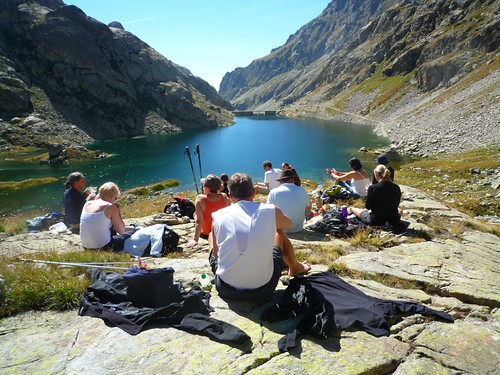
We have spent a week in the Parc du Mercantour with a group of managers from diverse industries. We call it a Time-Out.

The concept is simple:

We all live busy hectic lives at full speed – but when do we get a chance to call a Time Out and reflect on what we are doing or even just think about if we are heading in the right direction.

TimeOut_2010_MH - 021

The format is simple: Questions, dialog and reflection in nature. Healthy food, tons of fresh air and a bunch of delightful people.

Did I mention our coach?

TimeOut_2010_MH - 131

In my mind a coach is someone who helps you reach your own conclusions – someone who will help you to gain those elusive insights on your self.

Well, this mountain is an expert coach – i promise you.

… and the lunch breaks were not to bad either ;-)

TimeOut_2010_MH - 156

” Act alway as if the future of the Universe depended on what you did, while laughing at yourself for thinking that what ever you do makes any difference”

Filed Under: General

ProAction Cafe – a wonderful tool

April 30, 2016By Mike Hohnen

We kicked of Module 3, on our 3 year 6 module Service Management training this week. Seventeen energetic and ready-to -go ‘students’ worked for the days getting to grips with marketing of services and the role of loyalty and satisfaction.

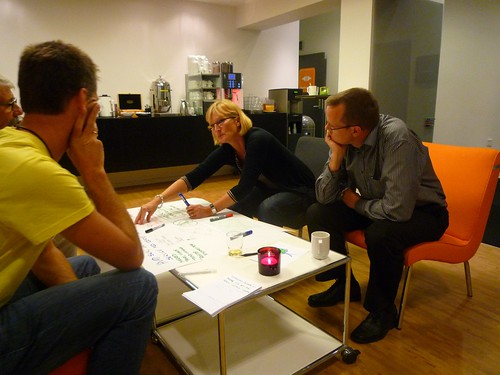
We wrapped up the 3 days with a ProActionCafe – a great new tool that we learned at our Art of Hosting training in Aarhus in August. The cafe combines the best of World Cafe, Open Space Technology and Action Learning.

Four students hosted 4 workshop on developing the focus for their action learning question – the question they will work on for the next 16 weeks and that will form the basis of their final written assignment in December. The Proaction Cafe was hosted by Kathrine Procter who is the Program Manager on this module and works with structured questioning in three rounds. Each round has 3 new expert help the host develop depth, perspective and action items on the chosen question.

L1010701

The feed back afterwards was awesome – not only did the 4 hosts declare that for the first time did they have a clear focus on their assignment at a very early stage but the other participants also felt that they had learned a lot about how they could approach their learning question.

An unexpected bonus that we had not thought of was that participants felt that working in the ProAction Cafe format also gave them a great opportunity to recapitulate the learning from the three previous days as they wove these topics into the problem solving discussion at the tables. It does not get much better in my world.

Powerful stuff – that we will develop further.

Filed Under: Hotel, Leadership/Management, Training & Development

Purpose goes mainstream…

April 14, 2022By Mike Hohnen

There is a certain interesting buzz in the air.

Maybe it is more than a buzz – maybe it is a fundamental shift..

It started out some years back as just a murmur or a slight rumbling from the initiated. But lately is has slowly risen in volume and my prediction is that before too long it will have gathered further momentum to become an unavoidable roar.

The shift is the call for ‘Purpose’

In a world with limited natural resources, huge inequality, and financial scandals galore, it is no longer comme il faut to do stuff just for money. That applies not just to companies that produce goods and services but is increasingly demanded by individuals as well – a job is no longer just for the money.

A new generation is emerging (see the generation M manifesto). They demand that we do stuff for a reason and it better be a good one – and just in case you are in doubt money is an outcome not a purpose.

The first time this was brought to my attention was 4 years a go sitting on a tree stump in the Rocky Mountains with my friend Lothar Friis. We were having a profound talk about life, business, gigs and all that. And Lothar said “you know in the end it all boils down to one thing: Purpose. If you have a clear purpose you will almost always bee successful in what you do.” That chat stayed with me rumbling around in my subconscious and I started becoming more aware of purpose as a concept.

The next time I noticed purpose was reading Fred Kofmans book Conscious Business.

A conscious business seeks to promote the intelligent pursuit of happiness in all its stakeholders. It produces sustainable, exceptional performance through the solidarity of its community and the dignity of each member.

In the book he says: “People do not consider Business an area to demonstrate their values .. Why not?”. Kofman asks you to think about a person you admire. Why do you admire that person? List the traits on a pice of paper (try it now by the way) What are the values on that list – probably words like integrity, honesty, caring, love, selfishness, you go on… Is that how business and work relations are run – probably not in most cases. Why not ?

He has a point why can’t we run our business with the same set of values that we would like to see in our local community. Well, five year ago you would be told that that is not the best way to maximize profits, but now it seem it just may turnout to be the only way to maximize profits – read on.

Then I read Peter Block’s “The answer to how is Yes” This opened my eyes to the need to ask ‘why’ before we ask ‘how’. The penny dropped. When we ask ‘Why’ we are looking at purpose (If you have not read it please do – it is a very important book.)

“We too often ask “How?” which focuses too closely on the practical way of getting something done and is actually a subconscious expression of society’s emphasis on control of people, time, and cost. Instead, our concentration should be focused on “Why?”. In other words, we need to pay attention to what really matters to us personally, from heart-felt commitments in our private lives to the creation of projects in the workplace. To be able to act on what matters, explains Block, we must reclaim specific qualities, such as intimacy and idealism. Then we can tackle purposeful work as if we were social architects seeking engagement and change.” (Amazon.com)

In 2006 Nikos Mourkogiannis published the book ‘Purpose – the starting point of great companies’ – a book that according to himself influenced John Mackey in his thinking and contributed to the creation of a new ‘movement’ called Conscious Capitalism that now holds thoughtful, exclusive by-invitation-only gatherings (Introduction to Conscious Capitalism).

FOLLOW YOUR HEART – John Mackey

In 2007 the book Firms of Endearment: How World-Class Companies Profit from Passion and Purpose is published – a book that was later adopted as the foundation for The Conscious Capitalism Institute (CCI)

“Conscious Capitalism is defined to have three elements; that companies should have a purpose transcending profit maximization, are managed for the benefit of all stakeholders and led by evolved, conscious servant leaders.”

By and by purpose has come out of the shadows of idealism and is going mainstream – obviously the financial meltdown of 2007/2008 has help this thinking a lot and contributed to more people have asking the crucial question: Why do we do what we do?

At TED 2010 Simon Sinek presented his ‘Golden Circle’ and showed that the way to the consumers heart starts with ‘why’ and not ‘how’.- Not as new a concept as he would like us to think but he deliveries the message in a very elegant and convincing way. Sinek has also written a great book on this called ‘Start With WHY’ that I can highly recommend.

SIMON SINEK

Then this spring Umair Haque made the case on his Harvard Business Review blog that doing good is not just good per see – it is just better business. The better Business Manifesto and Why Betterness Is Good Business

Clayton M. Christensen,
the Author of The Innovators Dilemma, (also on a HBR blog) then shows us all how important purpose is on a personal level. How Will You Measure Your Life?

“Don’t worry about the level of individual prominence you have achieved; worry about the individuals you have helped become better people. This is my final recommendation: Think about the metric by which your life will be judged, and make a resolution to live every day so that in the end, your life will be judged a success”

And finally this summer Dave Ulrich – not exactly a tree hugger – is out with a new book: The why of Work. Arguing in essence that if your employees don’t understand what you greater purpose is and how they can contribute to that they will be less motivated.

This morning in Fast Company we can read : Alex Bogusky Tells All: He Left the World’s Hottest Agency to Find His Soul

“Alex Bogusky, advertising Dadaist, postmodern media manipulator, pop-culture Houdini, daddy of 21st-century advertising, and now a seeker of meaning on the dirt path of life “ .. “ I guess I just don’t aspire to corporate legacy. I’m convinced that the greatness that matters more is the greatness people achieve through helping each other, through collaborating, more than the greatness that’s achieved by grabbing all you can or getting all you can or building all you can”

If you haven’t heard the cry for purpose – you are not listening – and very soon your customers (and your potential employees) are going to be asking you: “What is your purpose by the way?”. And if you don’t have a compelling answer, they will find someone else who does…

Filed Under: General, Leadership/Management, Marketing, Trends

Time out – All set for september 2010

April 14, 2022By Mike Hohnen

We have spent the past 3 days checkking out the location for our next Time Out – Tucked away high up in the mountains above Nice in the beautiful Parc du Mercantour.

Grand Chapelet - Mercantour - 5

You can just spot the hotel in right hand part of the picture. The road winds its way up from the village of Belvedere a distance of about 10 k’s and ends here at the entrance to the Parc. Once you reach this spot there is no longer mobile phone cover and the locals smile overbearingly and shake their heads when we ask for a high speed internet connection. No chance in this part of the world.

We all need to see the world from 2800m from time to time – it gives a different perspective and that is the whole idea behind this project

Grand Chapelet - Mercantour - 10

The surroundings are breathtaking and I am convinced that this setting will give our participants the opportunity to participate in a reflective process while at the same time getting to enjoy a series of physically challenging outdoor activities that we have planned – which is why we call it: Time-Out.

We shall be publishing more details on this event in the weeks to come – if you are very impatient drop me a note and I will tell you what I know at this point in time.

IMG_4354.JPG

Filed Under: General

The shift from teaching to learning

July 28, 2017By Mike Hohnen

Learning by discovery and collaboration once again proved its value.
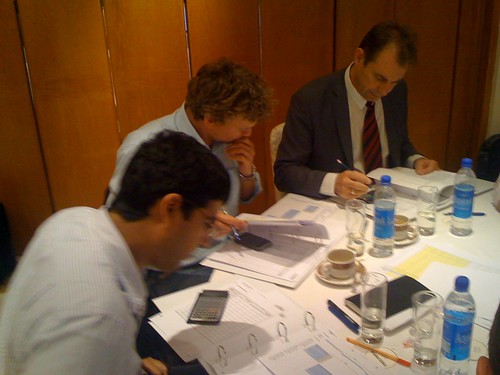
This week we spent time in Oman working with COWI Gulf. Together with their finance department we developed a 2 day training on the ins and outs of running a project from the financial point of view.I.e. are we on track financially, does this tally with our budget and that sort of stuff

IMG_0072

The challenge here is always: how does one make a subject fun and engaging when it is already considered drab and dull before we even get started.

The traditional approach is of course to arm yourself with a large deck of power-points outlining the does and don’t of financial management.

That may be how you teach finance – but that is not necessarily the best way to actually learn finance.

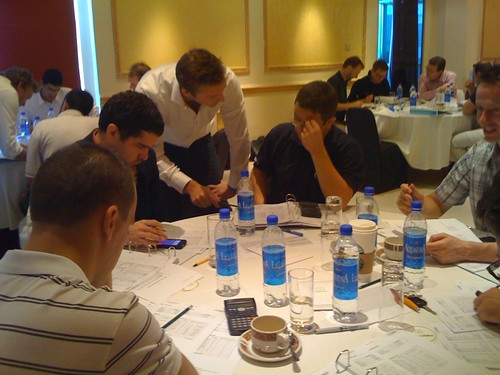
So instead we created a scenario that very much resembles their day to day situation, with the problems and pitfalls of real life and had them work through that in teams of 3 – if they got stuck they could ask questions – but essentially they worked it out between themselves – collaborative learning in full bloom – what a pleasure!

IMG_0077

Next week we shall take it up a notch…

Filed Under: GROW, Leadership/Management, Training & Development Tagged With: Action Learning

Are we suffering from Institutional sclerosis?

January 22, 2010By Mike Hohnen

Florida:

“It’s almost as if everyone is stuck in the same place. It seems to me that the mental models and frameworks of the Fordist economy, of the mass production economy, are so powerful and so deeply engrained in the way we think, it’s hard to think in other terms.”

Maybe we are managing ourselves to death – our core competency , managing, is becoming our major incompetency.

We need less management and more leadership.

Watch the inspiring interview with Richard Florida

Filed Under: General

What does this imply for training?

January 14, 2010By Mike Hohnen

What does it imply for the way we organise, hold meetings and…

“Conversations are the way workers discover what they know, share it with their colleagues, and in the process create new knowledge for the organization.
In the new economy, conversations are the most important form of work …so much so that the conversation is the organization.”
—Alan Webber, “What’s So New About the New Economy,” Harvard Business Review

Filed Under: Leadership/Management, Training & Development Tagged With: Learning, Meeting industry

  • « Go to Previous Page
  • Page 1
  • Interim pages omitted …
  • Page 31
  • Page 32
  • Page 33
  • Page 34
  • Page 35
  • Interim pages omitted …
  • Page 101
  • Go to Next Page »

Primary Sidebar

Search here

Recent Posts

  • Is Your Organisation Just an Expensive Collection of Parts?
  • When Managers Check Out, Everything Downstream Dies
  • Why “nice” leaders lose their people
  • Measuring the Unmeasurable
  • The Authenticity Paradox: When Being Real Means Being Responsive
  • The Manager as Culture Weaver, Not Compliance Officer
  • The Future of Digital Relationships
  • The Relational Load of Modern Leadership
  • The Psychological Cost of Wide Span of Control
  • The Hidden Cost of Cutting Middle Management

All you challenges at work are in reality realtionship challenges

Get fresh perspectives and practical wisdom on building authentic professional relationships that make your life easier.

Join my newsletter list here (published once a month)

The Legal Stuff

Terms & Conditions

Privacy Policy

© Copyright 2025 Thoughts4Action cc - Privacy Policy - Terms & Conditions

All your work challenges are really relationship challenges

Get fresh perspectives and practical wisdom on building authentic professional relationships that make your life easier.

Join my newsletter list here (published once a month)