• Skip to main content
  • Skip to primary sidebar

Mike Hohnen

Coaching for personal growth, change and development

  • ABOUT
  • SERVICES
  • LIBRARY
  • COURSES
  • LOGIN
  • BLOG

Blog Page

New skills are best learnt from peers…

January 12, 2013By Mike Hohnen

John Hagel:

There’s a big problem in the world of work: How do you keep your employees both happy and up to date on current trends?

John Hagel, co-chairman of Deloitte’s Center for the Edge, in San Jose, California, sees a major conundrum. Companies need to provide ongoing training for their employees – but traditional training programs tend to be backward looking. Hagel says research suggests that the best way for employees to learn new skills is not from classes and courseware, but instead from on-the-job training from peers

See the full article from Forbes here

Filed Under: General

What comes after the Service Profit Chain?

January 8, 2013By Mike Hohnen

What is great service?

Great customer experiences have an emergent quality. They arise out of a multiplicity of relatively simple interactions. Each one of them separately is quite simple – together they form a complex pattern that becomes an experience.

The challenge therefor lies not so much in the individual transaction – that is relatively easy – the art lies in the getting the combination right. The timing, the sequence the ’temperature’ – just like when you are baking a fruit cake.

When you bake a fruit cake you are in sync with you – hopefully. But when providing a great customer experience you need to be in ‘sync’ with everybody else (including the guest.) There needs to be a certain resonance between you and the rest of the crew.The better we ‘understand’ each other the easier it is to get it right.

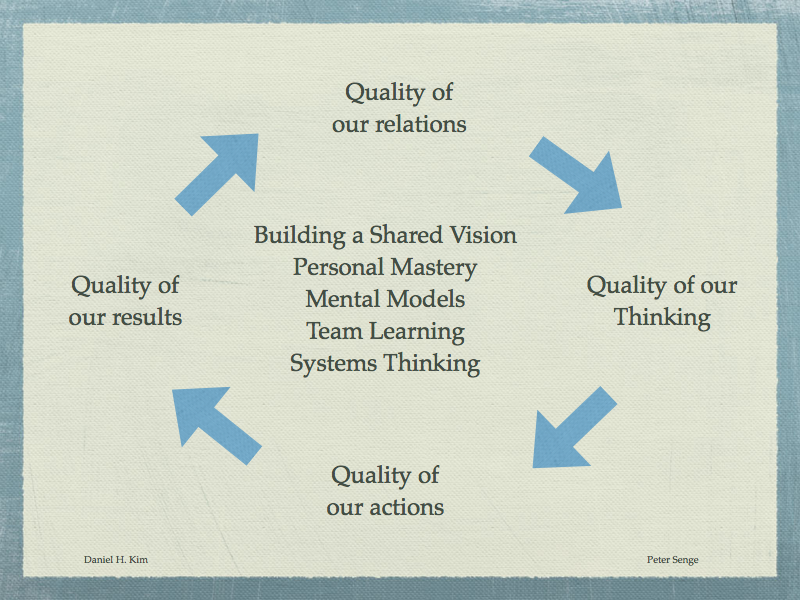
The key word therefore is relations.

The way we interact with each other – the quality of that relationship – drives our collective thinking and sensitivity to the situation.
The way we think and feel about what is going on has a huge influence on the quality of our actions. And as we all know the quality of our actions at the end of the day drives the quality of our results.

Which then brings us back full circle to where we started, because what we achieve and the way we achieve it drives the quality of our relations.

So what will it be?

We can go round this loop with a positive spin and things will steadily improve… or we can chose the downward route and things will go from bad to worse.

It all depends how we decide to relate to one another.

I only just recently discovered Daniel H. Kim’s model, I realize that is has been around for while. But nonetheless it struck me with great force because suddenly here was a way to describe what I have intuitively been working towards with many of my clients over the past years. I have just not been able to articulate it so clearly before.

In 2013 this kind of thinking is going to be at the foundation of what I shall be working on. It is the next step after many years of working with the Service Profit Chain.

Once we understand and how the Service Profit Chain works the next logical step for me is to look at our organizations from a relations perspective.

And the tools we shall be working with in order to achieve that are:

• Building a Common Vision
• Personal Mastery
• Mental Models
• Team Learning
• Systems Perspective

These five tools are also not new – they are at the core of Peter Senge’s The 5th Discipline. But although quite a lot of industry managers have heard of The 5th Discipline I see few who are actually working with or implementing this kind of thinking. ( That was also the the experience I had when I first started introducing the Service Profit Chain – People might have heard of it but it remained something relatively abstract – and very few were actually implementing it).

So what do you think? Do you have a team or and organization that would benefit from taking a walk down this path? Or do you have something you would like to contribute?
Let me know I am very curious as to how this resonates with you.

Filed Under: General, GROW, Hotel, Leadership/Management, Learning, Training & Development

We run on ideas…

April 14, 2022By Mike Hohnen

Filed Under: General

TEN “Obvious” Questions Concerning Your First-line Supervisors

April 21, 2016By Mike Hohnen

I have been a HUGE Tom Peters fan for years. I read In Search of Excellence and have been hooked ever since.

Recently TP has generously been sharing his collected wisdom in the form of the famous TP PPT slide sets. You will find them on his web site here.
There are 23 slide sets in total – more than 3500 slides of wisdom and/or provocation – one set that is particularly close to my heart is no 3 : First-line Supervisors Rule.

Here TP asks these 10 ‘Obvious’ questions

TEN “Obvious” Questions Concerning Your First-line Supervisors

1. Are you, Big Boss, a … formal student … of first-line supervisor behavioral excellence?* (*Yes, this sort of thing can be formally studied.)

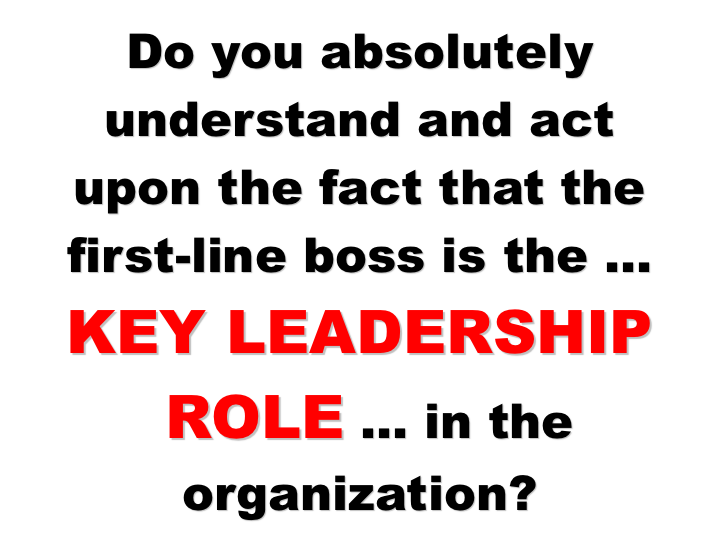
2. Do you absolutely understand and act upon the fact that the first-line boss is the … KEY LEADERSHIP ROLE … in the organization? Technical mastery is important—but secondary.

3. Does HR single out first-line supervisors individually and collectively for tracking purposes and special/“over the top” developmental attention?

4. Do you spend gobs and gobs (and then more and more gobs and gobs) of time … selecting … the first-line supervisors? Are your selection criteria consistent with the enormity of the impact that first-line bosses will subsequently have?


5. Do you have the … ABSOLUTE BEST TRAINING & CONTINUING DEVELOPMENT PROGRAMS IN THE INDUSTRY (or some subset thereof) … for first-line supervisors?

6. Do you formally and rigorously … mentor … first-line supervisors?

7. Are you willing, pain notwithstanding, to … leave a first-line supervisor slot open … until you can fill the slot with somebody spectacular? (And are you willing to use some word like … “spectacular” … in judging applicants for
the job?)

8. Is it possible that … promotion decisions … for first-line supervisors are as, or even more, important than promotion decisions for the likes of VP slots? (Hint: Yes.)

9. Do you consider and evaluate the quality of your … full set/CADRE …. of first-line supervisors?

10. Are your first-line supervisors accorded the respect that the power of their position merits?

Filed Under: General, Hotel, Leadership/Management, Training & Development

The job that needs to get done.

October 21, 2012By Mike Hohnen

Clayton Christensen – in his book The Innovators Dilemma has done a great job of explaining to us all why it is that time and again market leaders get ambushed by much smaller new entrants. If you have not read it please do it’s a fascinating read.

The classic scenario is that the much smaller new entrant launches a product that is obviously inferior from a quality point of view and therefore the existing players in the market don’t take it seriously. Ryanair is a good example of this and before them, Japanese car makers ambushed the American automobile industry with their compact cars.

And just now we are witnessing that the traditional newspaper industry is flapping around like headless chickens trying to come up with a business model that will save them from disappearing altogether – but they too woke up to late.

The key to understanding why this happens again and again is that established providers focus on their core customers and in that process lose sight of the job that needs to get done.
Take journalism, the demand for news is the same – but the way it is consumed has changed. My grandfather had the maid iron his newspaper before it was brought to him in his study. Well not many people consume news that way any more if you get my drift – but they still need it and somebody is providing it.

The reason I’m taking this up in my blog is because I have noticed how hugely popular a number of essentially couch surfing services have become. Airbnb seems to be the most visible but there are many others.

The concept enables private people to rent out their spare space to travelers. In Berlin a popular tourist destination hoteliers are now asking for government intervention, new rules and regulations because it is estimated that a whopping 5,000,000 bed nights a year are being supplied by private vendor’s. Interesting. Big chains are feeling threatened by small private vendors. What is going on?

Well, if we look at it through the lens of the job that needs to get done my interpretation is that this is not just about price – lots of private vendors are charging the same or more than your average budget hotel. I think this has more to do with hospitality – or the lack thereof.

If you visit a site like Airbnb.com and pick any popular city and look at the comments that some of the popular providers have on their listings from satisfied guests. What visitors appreciate is clearly the personal touch. The host that catered to a particular need, showed them the right dance club or whatever – in every case of a raving review it is clear that there was a real connection between the host and the guests. And that to me is what hospitality has always been about. That is the job that needs to get done.

But lately we have seen especially budget and mid priced hotels automating and streamlining their processes in order to cut costs. Check yourself in and out. Pick up your breakfast in the automate etc. But in the process they threw the baby out with the bathwater.

The obvious success of the couch surfing services is a big wake up call for the industry – we need to refocus on the job that needs to get done – which means being great hosts.

Filed Under: Hotel, Marketing

Applying Power & Love to the Service Profit Chain

September 18, 2012By Mike Hohnen

One of the misunderstandings that I often encounter when implementing the Service Profit Chain in organizations is that managers suddenly become reluctant to manage. I.e. they are reluctant to be directive or to set and enforce performance standards even when it is glaringly necessary.

They worry they will adversely affect the sacred employee satisfaction that is at the heart of the service profit chain thinking.

The problem is that it has exactly the opposite effect.

The team becomes uncertain, delivery of service sloppy and customer satisfaction goes out the window. And in the worst cases they conclude that creating a great place to works is a bad idea: “ just look what happens”.

They have not understood how to manage the polarities involved.

In order to explain what happens I use the work of a Adam Kahane on Power and Love.

First, we need to start with Adam Kahan’s definition of the two terms.

Power :“the drive of everything living to realize itself with increasing intensity”

Love : “the drive towards the unity of the separated”

So as we implement the service profit chain we definitely turn up the volume on the love part. In the process create a sense of unity, belonging and contribution from the ground level and up. That becomes our foundation

But now we have a situation from a polarity point of view that is often slightly lopsided. In order to balance the polarity and not end up in an anaemic, wishy-washy lovey-dovey kind of culture, it is important to increase the power side of the equation by raising the bar and setting high standards for performance and results.

When done in that order the result is a remarkable increase in commitment, motivation and performance.

This is actually quite logical if you think about it. Just feeling good (but getting nowhere) is not nearly as much fun or challenging as feeling good and achieving something significant.

So what happens is that when we increase the power side of the polarity in order to balance the love side we in fact increase employee satisfaction and loyalty as a result.

Martin Luther King put all this in a nutshell in this great quote:

”Power properly understood is nothing but the ability to achieve purpose. It is the strength required to bring about social, political and economical change…

And one of the great problems of history is that the concepts of love and power have usually been contrasted as opposites – polar opposites – so that love is identified with the resignations of power and power with the the denial of love.

Now we have to get this thing right.

What we need to realize is that power with out love is reckless and abusive and love with out power is sentimental and anemic. It is precisely this collision of immoral power with powerless morality which constitutes the major crisis of our time.”

Filed Under: General, GROW, Leadership/Management, Learning, Training & Development

The future of adult education is DIY

April 21, 2016By Mike Hohnen

A week or so ago I posted a video on the future of education because I found it most thought provoking. Read it here

But since then I have been wondering about what is happening to adult education, what we generally know as professional training and development. Over the past 10 to 15 years we have seen huge growth in companies specializing in all kinds of professional development: leadership communication, assertiveness etc. The list is endless. But I’ve noticed that over the past 2 years a lot of those companies are now mere shadows of themselves. They are just not doing the business that they used to. When I ask my friends and clients in the conference hotel business, they agree – that part of their market has decreased significantly.

So what has happened, have professionals stopped learning?

That is unlikely. The rate of change surrounding us is accelerating at an unprecedented rate and the need for further education and development has never been higher than it is now.

Something is changing

I think that 3 factors are influencing what is happening and that eventually will lead to a significant change in the way we think of professional development in the future:

70-20-10 – Learning frameworks is becoming a standard. That means that the focus is on, on-the-job-learning (70%) supported by peer coaching (20%) with just a dash of actual instruction added (10%).

Time – what I hear from HR managers again and again is that no matter how interesting, exotic and high flying propositions they come up with – they still have a very hard time getting people to actually sign up for the training offered. This has to do with the fact that everybody feels the pressure of more and more things that need to be done and not enough time to do them. So trainings that were previously considered a perk are now often considered an added burden.

Money  – the ROI of the stand alone 2 day training course is questioned. It is expensive to run and if on top of that you need to drag people in to actually attend – it is not the best starting point for any learning to take place.

So, invariably bosses are asking themselves could we do this differently?

My guess is that the onus is going to shift and the companies are going to come to the conclusion that they cannot take responsibility for the personal development of individuals. The competition for great jobs is only going to increase and therefore it’s going to be natural to say to those who would like the good jobs that they need to take responsibility for their own development.

Great companies will encourage and provide the space and opportunity for on-the-job learning, the best ones will also add (peer)-coaching and reflection as part of that package but the last 10% new knowledge is going to be left to the individual in some kind of DIY format.
My guess is that this will be e-learning driven to a large extent.

Not because e-learning provides the best training environment but because it solves the problem of time and money.

And in the same way that when we had to give up our music on vinyl and shift to CD’S and again to shift from CD*s to Mps3 we all cried: “Never will I live with that loss of quality” at the end of the day money and time made us accept a more convenient solution, although it was not as good as what we had.

What is your perspective on all this, I would really like to know?

Filed Under: GROW, Leadership/Management

The future of education

August 21, 2012By Mike Hohnen

Filed Under: General

  • « Go to Previous Page
  • Page 1
  • Interim pages omitted …
  • Page 21
  • Page 22
  • Page 23
  • Page 24
  • Page 25
  • Interim pages omitted …
  • Page 101
  • Go to Next Page »

Primary Sidebar

Search here

Recent Posts

  • Is Your Organisation Just an Expensive Collection of Parts?
  • When Managers Check Out, Everything Downstream Dies
  • Why “nice” leaders lose their people
  • Measuring the Unmeasurable
  • The Authenticity Paradox: When Being Real Means Being Responsive
  • The Manager as Culture Weaver, Not Compliance Officer
  • The Future of Digital Relationships
  • The Relational Load of Modern Leadership
  • The Psychological Cost of Wide Span of Control
  • The Hidden Cost of Cutting Middle Management

All you challenges at work are in reality realtionship challenges

Get fresh perspectives and practical wisdom on building authentic professional relationships that make your life easier.

Join my newsletter list here (published once a month)

The Legal Stuff

Terms & Conditions

Privacy Policy

© Copyright 2025 Thoughts4Action cc - Privacy Policy - Terms & Conditions

All your work challenges are really relationship challenges

Get fresh perspectives and practical wisdom on building authentic professional relationships that make your life easier.

Join my newsletter list here (published once a month)