• Skip to main content
  • Skip to primary sidebar

Mike Hohnen

Coaching for personal growth, change and development

  • ABOUT
  • SERVICES
  • LIBRARY
  • COURSES
  • LOGIN
  • BLOG

General

What has Value – From a Customer Perspective?

March 20, 2017By Mike Hohnen

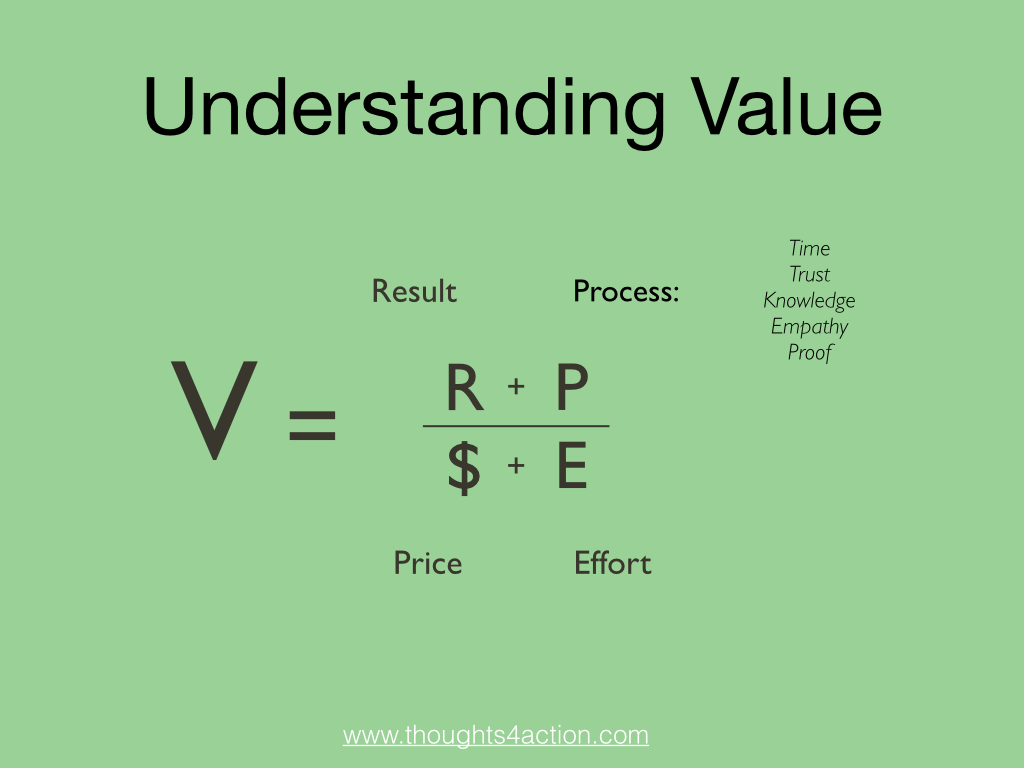
Value Equation

Why Value Is Not about Money

In the old economy – the one dominated by goods – value was created through the transfer of ownership. I create or produce something; and when I transfer the ownership to you, you give me money in return. The way you check the value of what you bought has to do with the specifications. Whether you are looking for strawberries or a new car, it is about product attributes. This ‘widget’ is _______ (stronger, faster, slimmer, tastier…) than the other ones you have looked at.

In the new economy – the service economy – value is created in use.
When I rent a car, use a consultant, or search for a great place to stay for my vacation, there is no transfer of ownership. It is all about utility – I need something, and my preferred service is the one that best takes care of that need. When my need is met, it translates into a result for me. And most of us are more than happy to pay for getting the result we need.
So, if our aim is to create a great customer service experience, the starting point is to make sure that what we are offering matches the value expectation of the customer.

In order to do that, we use the Value Equation – a tool that originates from the research conducted to produce the Service Profit Chain framework. The Value Equation has four elements:

R Is for Result

What is the result that the client is expecting or looking for? Do we understand the need? If I buy an airline ticket from Paris to Rome, and we end up in Berlin, the airline did not deliver the result that I was expecting. So, no matter how cheap the ticket is or how many drinks they serve, it is a lousy service experience. Do you book a table in a restaurant because you are hungry? Maybe. More often, you have a different need. Maybe you are looking for a special moment, an occasion to celebrate or an ideal setting for a special conversation. Whatever it is, the food is just an instrument in providing the real result that you are looking for.
This means that for every service product we create, we need to ask ourselves, “What is the result they are looking for?”

P Is for Process.
You can fly from A to B with many different airlines. In general, they will all get you to where you planned to go; but each one does it their way. The difference comes out in their process.
From a customer point-of-view, a process has five elements. Each plays a part when evaluating to what extent the value proposition actually covered their needs.

 Time. How does time play into the need or result that they have? Is it important that we are on time? Is it important that we are fast or slow? If my wife and I are having dinner before the cinema, we are looking for one kind of time experience. If we are celebrating her birthday the following week, we are looking for a different kind of time experience. Same people, same restaurant, but different situations.

Reliability. Do we do what we say we will do? Are we consistent?
Competence. How does the customer experience the competence level of our employee at a given touchpoint? How well do our frontline teams respond when asked a question or a request for help?

Empathy. To what extent are our employees able to see the situation from the client’s point-of-view? When a customer feels understood, we are more than halfway to solving their needs.

Proof of service. Do we provide a service that the client does not notice – are there ways that we could remind the client that we are servicing them?
Under the fraction line we have –

$ for price and E for effort
The client pays a price for our service; but depending on the service package, they also put in more or less effort themselves. If you buy a sofa from IKEA, the price is low; but you put in quite a bit of effort yourself. If you fly Virgin Upper Class, they will pick you up at your office and take you and your stuff right to the plane. A different experience than flying Ryanair – and, to be fair, also at a different price point.
So, there you have it.

If you want to understand how customers perceive value, the value equation is your key. And, your starting point for developing a great customer experience is to understand how you tailor your customer value proposition to each segment using the Value Equation.

Simply enter your email below to download the Value Equation

Filed Under: General Tagged With: Customer Value, Customer Value Perception, Marketing, service, Service Profit Chain, Value

The Frontline Manager Makes the World go Around

April 13, 2022By Mike Hohnen

Ilustrations.001


Despite the fact that we read stories that companies such as Zappos and others are abolishing the role of middle management, the reality out there is that the vast majority of companies rely heavily on middle managers to keep the wheels moving.

So, unless you have embarked on the experiment of abolishing middle managers, there is a high likelihood that you recognize that your frontline managers are crucial to your business.

Take one metric. Staff turnover.

A controllable cost that also has a high impact on your customer loyalty and satisfaction. It is widely recognized that employee turnover is linked to the management style of the immediate supervisor.

Or, change management.

Whatever customer satisfaction strategy and tactics you are developing – the effort is wasted if your frontline is not implementing according to that plan.

The Frontline Manager is the Linchpin

But, how much attention are you giving the growth and development of those frontline managers?
If you are like most of the companies recently surveyed by HBR, not much.

What that same survey shows is that, paradoxically, the same companies that say the frontline manager is a linchpin in the organization also say that the same frontline managers need to develop a number of crucial skills, including organizational savvy, leadership, and talent development.

But they recognize that not much is being done in the company to actually develop those people – go figure.

The reality out there – still according to the HBR survey – is that most development for this level of management tends to be ad hoc, sporadic, or just too brief to actually make a difference.

In general, it seems that leadership development follows the trickle-down model. Most gets invested at the top; and if there are resources left, they are spent on the frontline managers – sometimes.

So, once again, we have a classic knowing – doing gap. The problem is recognized – but somehow nothing gets done.
I wonder why.
Let’s just recap why frontline leadership is crucial to your service organization. We live in a world of Hypercompetition. Customers are flooded with offers and messages. In every imaginable category, supply outstrips demand.

So, if you are not just going to live a mediocre existence trying to survive, you need to stand out and be, if not the absolute best, then at least among the best.

Your aim is customer loyalty. If you can get that right, you will drive profits and growth as a result. This is the basic learning from the research done that led to The Service Profit Chain.

The best starting point for developing your frontline managers is to introduce them to the Service Profit Chain framework.

If you would like a refresher course on the mechanics of the Service Profit Chain and how employee engagement ultimately leads to profit and growth, check out my free video course here: 

Filed Under: General, Hotel, Leadership/Management, Learning, Training & Development Tagged With: Change, Employee loyalty, Hospitality, Leadership, Service design, Service Profit Chain

A Managers Guide to a Dream Team

April 14, 2022By Mike Hohnen

DreamTteam

The Service Profit Chain is a well-documented concept.

Since the original research was published in 1989, hundreds of articles have promoted the original findings which essentially boil down to the fact that happy employees create happy customers – and the happier the customers you have, the more money you make –
Yes, I know that was a very simplified version.

What not so many people talk about, or even document, is that this concept of ‘happy employees’ is not so much a question of employee satisfaction but, to a much higher degree, a question of employee engagement.
So, what are the steps to producing a high level of engagement on a service team?
According to the original research in The Service Profit Chain, there 8 steps in a self-reinforcing cycle called the dream team cycle.
Look closely and you will recognize that this is exactly what the best high profile service companies do:

The Right Team
Careful selection of new recruits. Hire for attitude. Train for skills.Coach for performance and that includes dealing with the bad apples.
Continuous Improvement
Best in class training and development at all levels in the organization. Continuous improvement is considered one of the great benefits of the job. “In this job, I grow”…
Great Support Systems
Service is not just something the frontline does for our customers. Service is our culture. Employees and managers who do not have customer contact service the employees that do. (Our IT department is not the IT-Police – it is an internal service department that supports the frontline in getting the job done.)
Empowerment
The best service employees take pride in solving the problem on the spot. So the freedom to act is hugely motivating. Southwest Airlines famously tells its employees, ”You may do anything you are not uncomfortable doing to solve a passengers problem.”
Clear Expectations
In the same way that anyone who has made it to a great sports team knows what is expected of them, employees in the best service organizations also know what is expected of them. It is part of their motivation to be part of a team that is not afraid to set the bar high.
Appropriate Rewards and Recognition
Focusing on what works, celebrating success, and acknowledging each others contributions makes work meaningful.
High Levels of Satisfaction and Engagement
As a result of Steps 1-6, we generate not just higher levels of satisfaction, but also real engagement – Service work becomes fun and meaningful.

Employees Recommend New Employees
When we need to recruit new team members, our best employees recommend friends and previous colleagues from other organizations because these are the people they would like to work with. Gradually we become the preferred employer in our region – which means we get the pick of the crop.

And that takes us back to Step 1 – The Right Team.
Done consistently this 8-step cycle become a self-reinforcing process that propels our service delivery capacity to higher and higher levels – and we all know what that does for our customer satisfaction and loyalty.

——

Building a great service business begins with understanding the Service Profit Chain framework. In my view, that is the foundation. Check out my free introduction here

Filed Under: General, Leadership, Service Profit Chain, Training & Development Tagged With: customer experience, Employee loyalty, Leadership, Service Profit Chain

Management Team or Just Heads of Tribe?

April 14, 2022By Mike Hohnen

Headsoftribe.002

Often when I work with a GM and the department heads, I will start by asking each of them to write down the name of a person on their team – just the first name that comes to mind.  Then I ask them who in the group has written the name of a person who is in this room now on their piece of paper. And invariably, it will always be only the GM who raises his hand. The GM sees the other people in the room as his team. But, the department heads seldom see each other as the team.

Department heads tend to see themselves as Indian chiefs. Each represents his or her tribe; and when they meet, it is about defending territory and resource allocation, not about collaboration.

Two Different Cultures:  Taking Responsibility and Being held Responsible –

They key to understanding why department heads end up as heads of a tribe and not as the team we dream about has to do with how we work with responsibility.
If we spend our time at management meetings trying to identify who was responsible for ‘That’ when something goes wrong, then each department head learns that the only way you can play that game and not get hurt is to create clear boundaries. ‘This is what I am responsible for – and that is what you are responsible for. Just make sure you don’t cross that line.’
The savviest department heads also learn not to stick their necks out and take on more responsibility than they need to.

Responsibility means trouble.

So, over time leaders  (and their teams)  become more and more passive and reactive.

But, we all know that being passive/reactive is not what gets us raving customer reviews. In order to rise to the top in our category, we need to be proactive. Managers and their teams need to take initiatives and anticipate needs in order to delight customers.

But, they will only do that if:
a) it is accepted that boundaries between departments are soft and
b) that we do not ‘punish people’ for taking initiative even when they are not successful.
That means a different culture.

Taking Responsibility

The alternative to being held responsible is to develop and encourage a culture where we take responsibility.

But that is a completely different culture; because, if you think about it, no department is an island. The boundaries we have created between departments are, in reality, just here for our own sake so that we can organize stuff in a meaningful way. From the customer’s viewpoint, these boundaries should be invisible.
The customer is looking for a total experience – the whole.
And because no department is an island, when something goes wrong, in most cases it goes wrong for a number of reasons – not just for one reason.

So, the question we need to always ask ourselves when something goes wrong is: “What could WE have done to prevent this happening?” Then, maybe department head A immediately jumps in and says: “That was my fault. I screwed up, and I will do my best not to make that mistake again.”  Case closed and we can move on to the next item on the agenda.

If that does not happen, we need to analyze what happened, not to place the blame, but to learn how we could have prevented this… most probably, with better collaboration at some level.
Because – if you remember – the definition of a team is:

A group of people with a common goal and who feel mutually responsible for reaching that goal.

Feedback Drives our Behavior.

Everything that we do is based on our previous experiences or our beliefs about what an experience will be. So, as the leader, your feedback to your team governs their behavior, and over time they become a reflection of your feedback.

And, they will either become a team or they will default to heads of tribe – it’s up to you.


Building a great service business begins with understanding the Service Profit Chain framework. In my view, that is the foundation. Check out my free introduction here:

Filed Under: General, Hotel, Leadership, Leadership/Management, Service Profit Chain

In a Sea of Sameness, We need to Manage the Experience

May 17, 2015By Mike Hohnen

15998442_m


We have been talking about the experience economy for years, but what does it mean to create an experience?

And, have you ever wondered who is responsible for the total experience in your company?

Most companies I work with have subdivided the responsibility for the experience into various sections – the kitchen is responsible for the food experience, the restaurant  for the table service, the reception desk for the welcome.

When doing it that way, we hope that if each of them do it well, then the total experience is going to be the best possible experience.

But if we were to apply that principle to manufacturing, we would be calling it sub-optimization. Ensuring that the parts are fantastic doesn’t guarantee that the total becomes fantastic. Purchasing the 11 best soccer players in the world does not guarantee a championship.

If you take your family to a theme park for the day – does it end up being a fantastic day because of one or two rides, or is it the integration of all the different experiences that blend into what you all feel was an exceptional day?

So, how do we ensure that the overall experience is fantastic?

I became curious about all this because I came across an article that stated that 69%of major UK companies have a customer experience manager.

The financial sector and the telecom sectors seem to lead the way. In retail, we don’t see many; and I struggled to find any in the hospitality sector at all.

Interesting.

Why have people in finance and telecoms seen the need before everyone else to appoint someone senior to take responsibility for the total experience of our customers?

I think this has to do with the fact that in the financial sector and the telecoms sector, they have a huge challenge in differentiating their product.

Once you have obtained your overdraft facility or your loan or whatever it is you want from a financial company, the difference in the actual product is not clear. A loan is a loan. The same applies to the telecom sector. If I send you an SMS, it’s difficult to know if it has been sent through Telia or Orange or whoever it is. The quality of the SMS doesn’t vary from one telecom provider to the other – although the content may vary… but that is another story.

What does vary from company to company is the actual experience you have when applying for your loan or creating your mobile phone account. Paying your bill etc.

This is something that Virgin understood years ago.

They took boring industries and tried to see if they could improve the experience. Not a cheaper experience but a more interesting or fun experience. They did it to the airline industry, they did it to trains, they’ve done it in the banking sector, telecoms, and fitness centers.

So why is the retail sector or the hospitality sector not concerned about the total customer experience – they stand out as the two sectors who don’t seem to employ customer experience managers?

They don’t see the need because when you have a shop or a hotel and you stand inside your own business and look out into the world, you are convinced that what you have is very different from any of the other products out there. Furthermore, you are convinced that, of course, the customers can tell the difference between your beautiful shop and all the other mediocre shops that are out there. It is obvious. But if you switch perspective and look at the marketplace through the eyes of the customers, what they see is a sea of sameness.

From the customer’s point of view, in each category they are all similar products that do the same things at the same prices, etc.

Which is why we have now come to a point where customer service is probably the last frontier of a sustainable competitive advantage. Products are very similar; process – the way we do things – is the differentiator.

So, if you want to out-perform your competition, you need to focus on your processes. How do all the things we do blend into that great total and unforgettable experience?

In the following blog posts, we will take a closer look at what that means.

Filed Under: Design, General, Hotel, Trends Tagged With: customer experience, cx, service, Service design, service design thinking

Potential ÷ Interference = Performance

May 17, 2015By Mike Hohnen

Challenges

I am a great believer in this simple formula:

Potential ÷ Interference = Performance

Fundamentally, all individuals, teams, and organizations have huge potential. They don’t always realize it – but they do. If they are not reaching that potential, it is because something is getting in the way. We call that interference.

If you don’t feel that you or your team are achieving your full potential, it is probably due to some form of interference.
Maybe you know the cause, but often it is a question of a blind spot.

In either case, you are stuck until we can get whatever it is out of the way.

And that is what I, as a coach, can help you with.

Filed Under: Coaching, General, Leadership/Management, Training & Development Tagged With: Change, Learning, Stuck, unstuck

Why Culture Beats Process

May 17, 2015By Mike Hohnen

Culture2
I am researching for a workshop that I will be conducting next week on culture and performance. One of my favorite subjects.

The evidence is very clear: Everywhere we find exceptional customer service, we invariably also find an amazing culture. Culture and performance are inseparable.

It’s not surprising though, if you think about it, your complete customer experience is a direct reflection of your culture. Makes perfect sense.

During my research, I came across this beautiful quote from Brian Chesky, Co-founder, CEO of Airbnb. This is part of a longer letter that he had written to his team, which was later published in Medium:

So how do we build culture?
By upholding our core values in everything we do. Culture is a thousand things, a thousand times. It’s living the core values when you hire; when you write an email; when you are working on a project; when you are walking in the hall. We have the power, by living the values, to build the culture. We also have the power, by breaking the values, to fuck up the culture. Each one of us has this opportunity, this burden.

Why is culture so important to a business?

Here is a simple way to frame it. The stronger the culture, the less corporate process a company needs. When the culture is strong, you can trust everyone to do the right thing. People can be independent and autonomous. They can be entrepreneurial. And if we have a company that is entrepreneurial in spirit, we will be able to take our next “(wo)man on the moon” leap.

Ever notice how families or tribes don’t require much process? That is because there is such a strong trust and culture that it supersedes any process. In organizations (or even in a society) where culture is weak, you need an abundance of heavy, precise rules and processes.

Read the full article here

Great service is all about engagement in the front line.

But engagement is inseparable from empowerment.

Empowerment is culture.

Filed Under: General, Leadership/Management, Marketing, Trends Tagged With: Culture, cx, Leadership, service

Customer Centric : they get it – Virgin Hotels

April 13, 2022By Mike Hohnen

In my previous post, I tried to illustrate how some hotels (and other service businesses) truly understand what it means to be customer centric and then all the others who really just don’t get it.

Two days after posting that I came across the following video from Virgin – who is now entering the hotel industry.

This is interesting because Virgin has always had a strategy of moving into industries where most of the players just don’t get it… Airlines, trains, banks, phone providers, and now hotels. What it means is that Virgin sees an opportunity to do it much better…there is room for improvement… Check out their website

Virgin Hotels – ‘Brilliant’ Not To Scale New York. from Not To Scale on Vimeo.

We make love and steal hearts. We’re passionate about creating brilliant experiences that make peoples’ lives better. And there’s nothing more honorable than that.

Filed Under: Design, General, Hotel Tagged With: Change, customer experience, cx, Hospitality, Hotel, Service design, Service Profit Chain

  • « Go to Previous Page
  • Page 1
  • Interim pages omitted …
  • Page 16
  • Page 17
  • Page 18
  • Page 19
  • Page 20
  • Interim pages omitted …
  • Page 42
  • Go to Next Page »

Primary Sidebar

Search here

The Legal Stuff

Terms & Conditions

Privacy Policy

© Copyright 2025 Thoughts4Action cc - Privacy Policy - Terms & Conditions

All your work challenges are really relationship challenges

Get fresh perspectives and practical wisdom on building authentic professional relationships that make your life easier.

Join my newsletter list here (published once a month)