• Skip to main content
  • Skip to primary sidebar

Mike Hohnen

Coaching for personal growth, change and development

  • ABOUT
  • SERVICES
  • LIBRARY
  • COURSES
  • LOGIN
  • BLOG

Mike Hohnen

Join us for the ALIA Europe programme

April 21, 2016By Mike Hohnen

In less than two months the ALIA Europe programme will be in full swing.

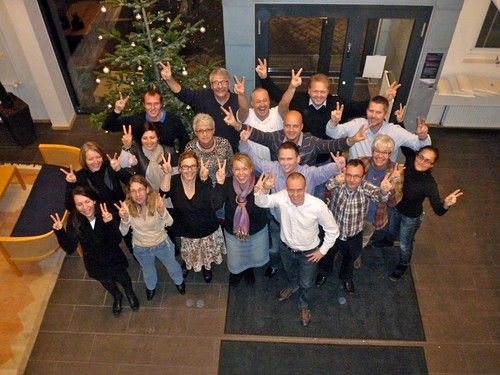
I am looking forward to being among the 100+ learners convening around authentic leadership in action. It will be a programme rich in design, and also in the diversity and life experience of the people in attendance. Participants are coming from Australia, Belgium, Canada, Denmark, France, Germany, Ireland, Netherlands, South Africa, Sweden, Switzerland, the United Kingdom, and the United States. This learning community, while coming face-to-face for a brief 6-day period, is part of a global movement of community and organizational leaders and followers striving for more effective, more humane living and working environments.

You can download the brochure here

Filed Under: Leadership/Management, Training & Development Tagged With: ALIA

Are you enjoying the conferences you attend?

November 19, 2009By Mike Hohnen

Here is a simple survey – try it out and see how you view matches that of others.

Filed Under: General

Fagre ny økonomi

April 19, 2016By Mike Hohnen

[lang_da]Af Mike Hohnen

Børsen havde i fredagens Executive tillæg 3 artikler, der alle slår på et tema vi har været omkring ved flere lejligheder på to Grow’s diplomlederuddannelse:

1. Kun de stærkeste overlever opsvinget
Med rubrikoverskriften “kunder vil se værdi”.

2. Strategisk nytænkning
Skrevet af Steen Hildebrandt. Vi vidste godt, der var for mange ting, som den kortsigtede optimeringspraksis ikke tog hensyn til.

..Det vigtigste er en forretnings model der tager udgangs punkt i at det væsentlige er levende systemer…

3. Skab dit eget momentum

…ved at skabe nye værdier for sine kunder skaber man virkelig vækst…

Ud på den anden side – en ny begyndelse
Jeg har desuden lige set et videoklip med en af Deutche Bank’s cheføkonomer, som forklarer, hvorfor det her ikke handler om et lille dyk i vækstkurven – men er en længerevarende forestilling.

Også Wired magazine i denne uge en artikel med overskriften: “This crisis is not just the trough of a cycle but the end of an era. We will come out not just wiser but different.”

Jeg skrevet om de her tendenser tilbage i august – Getting to grips with the big shift.[/lang_da]

Filed Under: General

Kick-off i Berendsen Textil

April 21, 2016By Mike Hohnen

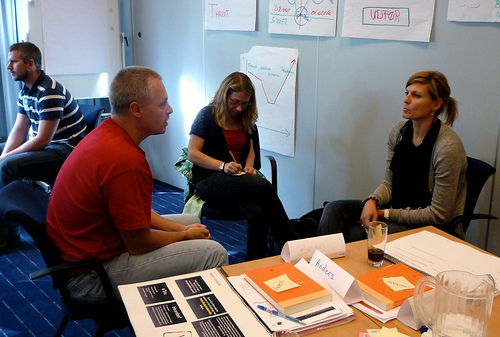
[lang_da]Det første GROW Leadership forløb for mellemledere i Berendsen Textil er skudt i gang, og kick-off modulet fokuserede i høj grad på Service Profit Chain, og hvordan man skaber intern kvalitet i sin virksomhed.

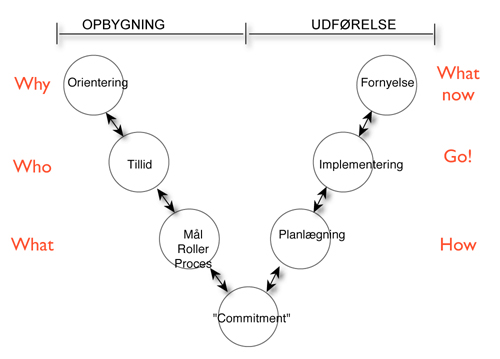
Vi brugte en del kræfter på at arbejde med Team V-modellen og teamforståelse. Team V-modellen er kort beskrevet en model over den proces, der skal til for at skabe et stærkt team.

Først skal man bruge tid på at skabe tillid, en fælles forståelse og afklaring af forvententninger i gruppen – og definere gruppens mål og og indbyrdes roller (ved at arbejde sig ned gennem den ene side af v’et). Det kan man gøre ved at lave et ‘team manifest’ ud fra nogle centrale spørgsmål, der skal klarlægge gruppens potentiale:

  • Hvad er formålet?
  • Hvilke milepæle har vi?
  • Hvilke afgrænsninger har vi?
  • Hvilke ressourcer har vi?

  • Først da er man klar til at skabe et ‘commitment’ i gruppen og lægge en plan for udførelsen af et givent projekt (ved at arbejde opad gennem den anden side af v’et)

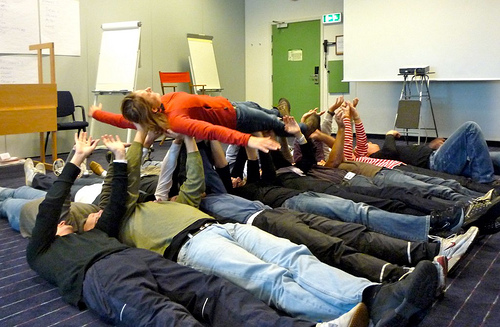
    Vi arbejdede med forskellige øvelser, der havde det formål at øge forståelsen for Team V-modellens funktion og vigtighed i gruppeprocesser – så budskabet ikke kun blev forstået intellektuelt, men af hele kroppen.

    [/lang_da]

    Filed Under: General

    “How can we improve learning in organizations?”

    April 14, 2022By Mike Hohnen

    Jay Cross asks the question:

    Here is Jay’s website with more on informal learning

    Filed Under: General, GROW, Leadership/Management, Training & Development Tagged With: Informal Learning

    Musen er død…

    April 13, 2022By Mike Hohnen

    [lang_da]Det er ikke alt, hvad Alexander Kjærulf siger, jeg er helt enig i, men i hans pointe om den dødssyge mussamtale, har vi gjort mange af de samme observationer.

    Den er for mig en forfærdelig sutteklud, som i bedste fald ikke gør nogen skade, men i værste fald er voldsomt demotiverende. Det er en sutteklud, fordi den giver mange ledere en illusion om, at de gør det de skal i form af feedback.

    Men forestil dig at du var tenniscoach og du har fået opgave at coache et supertalent
    – ville du gøre det ved at holde årlig MUS-samtale?

    Masser af lederer bruger MUS-samtalen som undskyldning for ikke at bruge tid i dagligdagen på at give løbende feedback: “Vi tager det til MUS’en”…

    Feedback is the breakfeast of champions – det er ingen tvivl om, at der er en tæt sammenhæng mellem performance og feedback. Det er derfor, at tenniscoachen står på sidelinjen og giver sin spiller feedback under træningen. Masser af feedback – hele tiden.

    Det der virkelig giver arbejdsglæde er at vide, at man bidrager, at det ikke er ligegyldigt om man er der – at gå hjem og føle, at man har gjort en forskel er helt afgørende. Måden man bliver klar over det på er gennem feedback – masser af feedback.

    Men læs selv Alexanders indlæg her
    [/lang_da]

    Filed Under: General, Leadership/Management Tagged With: Employee loyalty

    Our NPS is 83% as of today…

    April 21, 2016By Mike Hohnen

    We often use the net promoter score in our trainings – it is a great tool to show participants the value and power of customer loyalty.

    So why not practice what we preach?

    We always ask our participants the final key question before they leave us:
    “On a scale of 1 to 10 how likely is it that you would recommend this training to a friend or colleague?

    We have added up the evaluations for trainings that we have done during the first 6 months of 2009. And I am both happy and proud to say that our NPS score is running at 83% – not bad ! ( If you are wondering how one calculates the NPS score you can see more here

    We have previously written about NPS on this blog here

    Filed Under: General

    Getting to grips with the Big Shift

    April 21, 2016By Mike Hohnen

    [lang_en]For a while now I have been talking to friends and colleagues about this gut feeling that I have, that what we talk about as the economic crisis or downturn is possibly not a traditional crisis and/or downturn in the sense that once it is over things will return to normal.

    I have this very clear feeling that a fundamental shift in many of the ways that we have been used to conducting business and interacting with each other is underway. (see also my previous post are you a frog in the pot) And that when the dust settles things will not return to what we have known previously as normal but will have undergone a clear shift. This is not a passing storm but fundamental climate change.

    In pursuit of that theme I have been hunting for signs that would support this gut feeling.

    This has led me to The 2009 Shift Index published by Deloite and presented on the Harvard publishing website.

    Her you will find the following resume of key findings:

    The 2009 Shift Index reveals a disquieting performance paradox in the US corporate sector. On the one hand, labor productivity has nearly doubled since 1965. During those same years, however, US companies’ Return on Assets (ROA) progressively dropped 75 percent from their 1965 level.

    How can firms be getting lower returns even as they’re becoming more efficient? The answer resides in the heightened competition among firms. Competitive intensity nearly doubled between 1965 and 2008, forcing firms to compete away the benefits of productivity gains, which were instead captured by creative talent in the form of higher compensation and numbers of consumers through increasing performance/price ratios and wider choice.

    It’s little surprise to find also that the highest-performing companies are struggling to maintain their ROA rates and are increasingly losing market leadership positions. Taken as a whole, the findings portray a U.S. corporate sector in which long-term forces of change are undercutting normal sources of economic value. “Normal” may in fact be a thing of the past: even after the economy resumes growing, companies’ returns will remain under pressure.

    To respond to this performance challenge, U.S. companies will need to let go of industrial- era organizational structures (and the reporting relationships, incentive systems, and managerial processes that go with them) and operational practices in favor of the new institutional architectures and business practices needed to create and capture economic value in the era of the Big Shift.

    Companies must move beyond their fixation on getting bigger and more cost-effective to make the institutional innovations necessary to accelerate performance improvement as they add participants to their ecosystems, expanding learning and innovation in collaboration curves and creation spaces. Companies must move, in other words, from scalable efficiency to scalable learning and performance. Only then will they make the most of our new era’s fast-moving digital infrastructure.

    So what does this Big Shift entail in pratical terms?

    John Hagel one of the co-authors of the 2009 Big Shift index does a superb job summarizing what he essentially sees as a shift from push to pull on his blog Edge Perspectives

    What obviously caught my atention was this:


    From knowledge transfer to knowledge creation

    Most companies today will acknowledge the importance of knowledge flows, but they tend to focus on transferring knowledge more efficiently, especially within corporate boundaries. While useful, this is ultimately a diminishing returns game on multiple levels. The greatest economic value will come from finding ways to connecting relevant yet diverse people, both within the firm and outside it, to create new knowledge. They do this best by addressing challenging performance requirements that motivate them to get out of their comfort zone and come up with creative new approaches that generate more value with fewer resources.

    This correlates well with the experiences that we have using action learning as our primary developmental tool in helping managers and organizations tackle the changes that they are in. It is not our job to teach but to help them learn – and that is a very different story.

    But I urge you to read the full unfolding of this thinking here under the following headlines:

    From knowledge stocks to knowledge flows.

    From knowledge transfer to knowledge creation.

    From explicit knowledge to tacit knowledge.

    From transactions to relationships.

    From zero sum to positive sum mindsets.

    From push programs to pull platforms.

    From stable environments to dynamic environments.

    Lots of food for thought, and now I realize that my gut was telling me something important and I shall continue to pursue this investigation.[/lang_en]

    Filed Under: Design, General, GROW, Leadership/Management, Training & Development, Trends Tagged With: Action Learning, Big Shift, Change

    • « Go to Previous Page
    • Page 1
    • Interim pages omitted …
    • Page 33
    • Page 34
    • Page 35
    • Page 36
    • Page 37
    • Interim pages omitted …
    • Page 101
    • Go to Next Page »

    Primary Sidebar

    Search here

    The Legal Stuff

    Terms & Conditions

    Privacy Policy

    © Copyright 2025 Thoughts4Action cc - Privacy Policy - Terms & Conditions

    All your work challenges are really relationship challenges

    Get fresh perspectives and practical wisdom on building authentic professional relationships that make your life easier.

    Join my newsletter list here (published once a month)