“Every act is a marketing act. Make every employee a marketing person.”

What comes after the Service Profit Chain?

What is great service?

Great customer experiences have an emergent quality. They arise out of a multiplicity of relatively simple interactions. Each one of them separately is quite simple – together they form a complex pattern that becomes an experience.

The challenge therefor lies not so much in the individual transaction – that is relatively easy – the art lies in the getting the combination right. The timing, the sequence the ’temperature’ – just like when you are baking a fruit cake.

When you bake a fruit cake you are in sync with you – hopefully. But when providing a great customer experience you need to be in ‘sync’ with everybody else (including the guest.) There needs to be a certain resonance between you and the rest of the crew.The better we ‘understand’ each other the easier it is to get it right.

The key word therefore is relations.

The way we interact with each other – the quality of that relationship – drives our collective thinking and sensitivity to the situation.
The way we think and feel about what is going on has a huge influence on the quality of our actions. And as we all know the quality of our actions at the end of the day drives the quality of our results.

Which then brings us back full circle to where we started, because what we achieve and the way we achieve it drives the quality of our relations.

So what will it be?

We can go round this loop with a positive spin and things will steadily improve… or we can chose the downward route and things will go from bad to worse.

It all depends how we decide to relate to one another.

I only just recently discovered Daniel H. Kim’s model, I realize that is has been around for while. But nonetheless it struck me with great force because suddenly here was a way to describe what I have intuitively been working towards with many of my clients over the past years. I have just not been able to articulate it so clearly before.

In 2013 this kind of thinking is going to be at the foundation of what I shall be working on. It is the next step after many years of working with the Service Profit Chain.

Once we understand and how the Service Profit Chain works the next logical step for me is to look at our organizations from a relations perspective.

And the tools we shall be working with in order to achieve that are:

• Building a Common Vision
• Personal Mastery
• Mental Models
• Team Learning
• Systems Perspective

These five tools are also not new – they are at the core of Peter Senge’s The 5th Discipline. But although quite a lot of industry managers have heard of The 5th Discipline I see few who are actually working with or implementing this kind of thinking. ( That was also the the experience I had when I first started introducing the Service Profit Chain – People might have heard of it but it remained something relatively abstract – and very few were actually implementing it).

So what do you think? Do you have a team or and organization that would benefit from taking a walk down this path? Or do you have something you would like to contribute?
Let me know I am very curious as to how this resonates with you.

Applying Power & Love to the Service Profit Chain

One of the misunderstandings that I often encounter when implementing the Service Profit Chain in organizations is that managers suddenly become reluctant to manage. I.e. they are reluctant to be directive or to set and enforce performance standards even when it is glaringly necessary.

They worry they will adversely affect the sacred employee satisfaction that is at the heart of the service profit chain thinking.

The problem is that it has exactly the opposite effect.

The team becomes uncertain, delivery of service sloppy and customer satisfaction goes out the window. And in the worst cases they conclude that creating a great place to works is a bad idea: “ just look what happens”.

They have not understood how to manage the polarities involved.

In order to explain what happens I use the work of a Adam Kahane on Power and Love.

First, we need to start with Adam Kahan’s definition of the two terms.

Power :“the drive of everything living to realize itself with increasing intensity”

Love : “the drive towards the unity of the separated”

So as we implement the service profit chain we definitely turn up the volume on the love part. In the process create a sense of unity, belonging and contribution from the ground level and up. That becomes our foundation

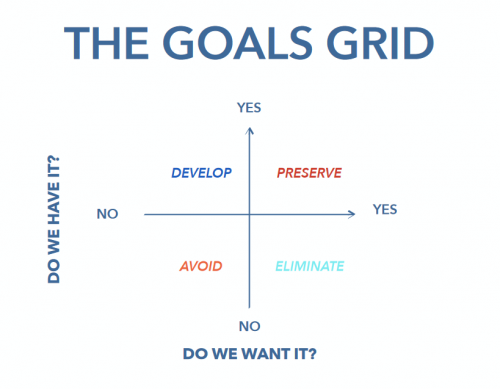
But now we have a situation from a polarity point of view that is often slightly lopsided. In order to balance the polarity and not end up in an anaemic, wishy-washy lovey-dovey kind of culture, it is important to increase the power side of the equation by raising the bar and setting high standards for performance and results.

When done in that order the result is a remarkable increase in commitment, motivation and performance.

This is actually quite logical if you think about it. Just feeling good (but getting nowhere) is not nearly as much fun or challenging as feeling good and achieving something significant.

So what happens is that when we increase the power side of the polarity in order to balance the love side we in fact increase employee satisfaction and loyalty as a result.

Martin Luther King put all this in a nutshell in this great quote:

”Power properly understood is nothing but the ability to achieve purpose. It is the strength required to bring about social, political and economical change…

And one of the great problems of history is that the concepts of love and power have usually been contrasted as opposites – polar opposites – so that love is identified with the resignations of power and power with the the denial of love.

Now we have to get this thing right.

What we need to realize is that power with out love is reckless and abusive and love with out power is sentimental and anemic. It is precisely this collision of immoral power with powerless morality which constitutes the major crisis of our time.”

A hard question for you as a leader

The name Barbara Kellerman showed up on my screen on a number of occasions this week.

The reason for this is her most recent book The end of Leadership in which she takes the whole leadership development industry (of which I am also part) to task for selling and promoting what at the end of the day turns out to be snake oil.

Leadership crisis

Her point is, that despite more than 50 years of countless leadership development courses, conferences and God knows how many books there is not much to be proud of when you look at the big picture. According to Kellerman only 7% of employees trust their employers, their leaders and managers and the vast majority of them do not consider their superiors to be either honest or competent.

Not impressive statistics by any yardstick.

But what struck me the most was this:

“Clearly one of the problems plaguing the leadership industry is its fixation on developing good leaders, while ignoring completely the problem of stopping or at least slowing bad leaders.”

Why is it that so many organisations are doing such an incredibly lousy job and weeding out the rotten apples?

Because Kellermann has a point. Time and again we see groups of managers being sent off on development courses/training but ‘Joe the terror’ is left to do what he has always done despite the fact that everybody recognises that there is a problem.

But not dealing with Joe the terror sends a very strong signal to the organisation.

One of the things that we know undermines trust dramatically is when leaders says one thing and do something completely different. They could just as well have created a huge poster and on it written: yes we send good boys and girls to leadership development courses because we know it keeps them happy and it’s the right thing to do – but the truth be told we don’t actually give a toss.
All we are looking for is results. So as long as someone is getting the numbers right they can forget about coaching, appreciative Inquiry and feed back and behave any way they like.

But getting the numbers is just one aspect.

The other part of being a good leader is relational. ( I like to call it Results vs Relations Kellerman calls it Effective and Ethical – Either way – to be a great leader you can’t have one without the other)

This point was brought home to me many years ago when I read Chip Conley’s The Rebel Rules: Daring to be Yourself in Business ( still a favourite book of mine) . In the book he has a chapter on performance management and gives an example of how they at Joie de Vivre Hotels evaluate their management teams on a 5 x 5 point grid with results on one axis and relations on the other axis. Conley makes the point that managers who do well on the results scale but badly on relationships need to be coached and made aware that they need to improve on this aspect – and ultimately, if they don’t get it right they will have to leave the organisation despite the fact that they are getting the numbers right. Anything else is shortsighted. (Obviously this also applies the other way round. If we have the nicest person on earth on our management team but who isn’t producing what needs to get done that person too must either shape up or ship out – being ethical but ineffective is also bad leadership)

The cost of bad leaders


If we’re trying to build a better service business following the principles of the service profit chain we also know that the number 1 factor affecting job satisfaction and loyalty of our best front-line people is their relationship with their immediate supervisor.
So some supervisors may be able to drive results short-term but the price they ( we ) pay is always that long-term they lose their best people. ( and we all know that losing our best people eventually leads to losing your best clients)

Furthermore by not dealing with the bad apples we send a strong signal to the other managers on the team that under performing behaviour is okay. As a result over time we develop a toxic leadership culture, with zero trust

Focusing only on bottom line results is a classic misconception. What many leaders in the service industry forget is that financials are lagging indicators – you will have had employee dissatisfaction and/or client dissatisfaction for a while before it actually shows up in your financials and by then it may be way to late to do anything much about it.

So now’s a good time to ask yourself the hard question: are you a good or a bad leader? In the sense do you deal effectively and ethically with your non-performing managers? Because if we want to rout out bad leadership and re-establish trust this is where it all begins.

The Social Nature of Brands

Great article in B+S

Some might attribute this trend — the increasing use of social engagement by marketers — to the rise of online social media: Facebook, Twitter, YouTube, fan sites, and social marketing websites (also known as private-label media) created by companies themselves. But the trend represents a more fundamental change in marketing practice, linked to insights from social psychology, behavioral economics, and neuroscience and brain research. Every form of interaction between companies and consumers — taking place online and offline, in stores and over mobile devices, in branded content and by word of mouth, and indeed through all direct consumer experience — is now understood to be shaped by the social nature of brands.

Read it all here : The Social Life of Brands

In my book Best! i also argue the point of the Ambassador effect and how it affects the Service industry – you can find the book here

Followership is Underated

Are we too focused on ‘Leadership’ – and not enough about ‘Followership*

What does it take to develop followership – check out this video

Google Find us on Google+