Charles Jennings introduces the concept of the 70 20 10 learning guideline, explaining how it can provide a new way to think.
General
New skills are best learnt from peers…
John Hagel:
There’s a big problem in the world of work: How do you keep your employees both happy and up to date on current trends?
John Hagel, co-chairman of Deloitte’s Center for the Edge, in San Jose, California, sees a major conundrum. Companies need to provide ongoing training for their employees – but traditional training programs tend to be backward looking. Hagel says research suggests that the best way for employees to learn new skills is not from classes and courseware, but instead from on-the-job training from peers
See the full article from Forbes here
What comes after the Service Profit Chain?
What is great service?
Great customer experiences have an emergent quality. They arise out of a multiplicity of relatively simple interactions. Each one of them separately is quite simple – together they form a complex pattern that becomes an experience.
The challenge therefor lies not so much in the individual transaction – that is relatively easy – the art lies in the getting the combination right. The timing, the sequence the ’temperature’ – just like when you are baking a fruit cake.
When you bake a fruit cake you are in sync with you – hopefully. But when providing a great customer experience you need to be in ‘sync’ with everybody else (including the guest.) There needs to be a certain resonance between you and the rest of the crew.The better we ‘understand’ each other the easier it is to get it right.
The key word therefore is relations.
The way we interact with each other – the quality of that relationship – drives our collective thinking and sensitivity to the situation.
The way we think and feel about what is going on has a huge influence on the quality of our actions. And as we all know the quality of our actions at the end of the day drives the quality of our results.
Which then brings us back full circle to where we started, because what we achieve and the way we achieve it drives the quality of our relations.
So what will it be?
We can go round this loop with a positive spin and things will steadily improve… or we can chose the downward route and things will go from bad to worse.
It all depends how we decide to relate to one another.
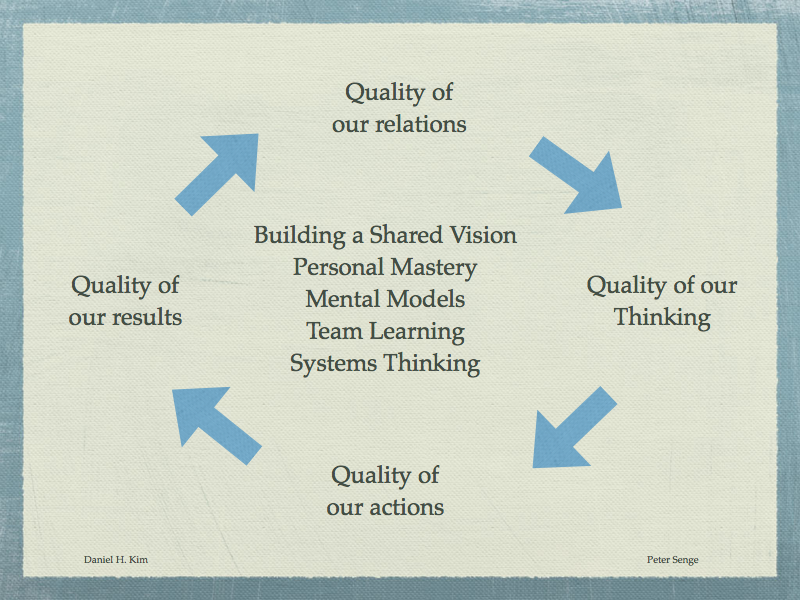
I only just recently discovered Daniel H. Kim’s model, I realize that is has been around for while. But nonetheless it struck me with great force because suddenly here was a way to describe what I have intuitively been working towards with many of my clients over the past years. I have just not been able to articulate it so clearly before.
In 2013 this kind of thinking is going to be at the foundation of what I shall be working on. It is the next step after many years of working with the Service Profit Chain.
Once we understand and how the Service Profit Chain works the next logical step for me is to look at our organizations from a relations perspective.
And the tools we shall be working with in order to achieve that are:
• Building a Common Vision
• Personal Mastery
• Mental Models
• Team Learning
• Systems Perspective
These five tools are also not new – they are at the core of Peter Senge’s The 5th Discipline. But although quite a lot of industry managers have heard of The 5th Discipline I see few who are actually working with or implementing this kind of thinking. ( That was also the the experience I had when I first started introducing the Service Profit Chain – People might have heard of it but it remained something relatively abstract – and very few were actually implementing it).
So what do you think? Do you have a team or and organization that would benefit from taking a walk down this path? Or do you have something you would like to contribute?
Let me know I am very curious as to how this resonates with you.
We run on ideas…
TEN “Obvious” Questions Concerning Your First-line Supervisors
I have been a HUGE Tom Peters fan for years. I read In Search of Excellence and have been hooked ever since.
Recently TP has generously been sharing his collected wisdom in the form of the famous TP PPT slide sets. You will find them on his web site here.
There are 23 slide sets in total – more than 3500 slides of wisdom and/or provocation – one set that is particularly close to my heart is no 3 : First-line Supervisors Rule.
Here TP asks these 10 ‘Obvious’ questions
TEN “Obvious” Questions Concerning Your First-line Supervisors
1. Are you, Big Boss, a … formal student … of first-line supervisor behavioral excellence?* (*Yes, this sort of thing can be formally studied.)
2. Do you absolutely understand and act upon the fact that the first-line boss is the … KEY LEADERSHIP ROLE … in the organization? Technical mastery is important—but secondary.
3. Does HR single out first-line supervisors individually and collectively for tracking purposes and special/“over the top” developmental attention?
4. Do you spend gobs and gobs (and then more and more gobs and gobs) of time … selecting … the first-line supervisors? Are your selection criteria consistent with the enormity of the impact that first-line bosses will subsequently have?
5. Do you have the … ABSOLUTE BEST TRAINING & CONTINUING DEVELOPMENT PROGRAMS IN THE INDUSTRY (or some subset thereof) … for first-line supervisors?
6. Do you formally and rigorously … mentor … first-line supervisors?
7. Are you willing, pain notwithstanding, to … leave a first-line supervisor slot open … until you can fill the slot with somebody spectacular? (And are you willing to use some word like … “spectacular” … in judging applicants for
the job?)
8. Is it possible that … promotion decisions … for first-line supervisors are as, or even more, important than promotion decisions for the likes of VP slots? (Hint: Yes.)
9. Do you consider and evaluate the quality of your … full set/CADRE …. of first-line supervisors?
10. Are your first-line supervisors accorded the respect that the power of their position merits?
Applying Power & Love to the Service Profit Chain
One of the misunderstandings that I often encounter when implementing the Service Profit Chain in organizations is that managers suddenly become reluctant to manage. I.e. they are reluctant to be directive or to set and enforce performance standards even when it is glaringly necessary.
They worry they will adversely affect the sacred employee satisfaction that is at the heart of the service profit chain thinking.
The problem is that it has exactly the opposite effect.
The team becomes uncertain, delivery of service sloppy and customer satisfaction goes out the window. And in the worst cases they conclude that creating a great place to works is a bad idea: “ just look what happens”.
They have not understood how to manage the polarities involved.
In order to explain what happens I use the work of a Adam Kahane on Power and Love.
First, we need to start with Adam Kahan’s definition of the two terms.
Power :“the drive of everything living to realize itself with increasing intensity”
Love : “the drive towards the unity of the separated”
So as we implement the service profit chain we definitely turn up the volume on the love part. In the process create a sense of unity, belonging and contribution from the ground level and up. That becomes our foundation
But now we have a situation from a polarity point of view that is often slightly lopsided. In order to balance the polarity and not end up in an anaemic, wishy-washy lovey-dovey kind of culture, it is important to increase the power side of the equation by raising the bar and setting high standards for performance and results.
When done in that order the result is a remarkable increase in commitment, motivation and performance.
This is actually quite logical if you think about it. Just feeling good (but getting nowhere) is not nearly as much fun or challenging as feeling good and achieving something significant.
So what happens is that when we increase the power side of the polarity in order to balance the love side we in fact increase employee satisfaction and loyalty as a result.
Martin Luther King put all this in a nutshell in this great quote:
”Power properly understood is nothing but the ability to achieve purpose. It is the strength required to bring about social, political and economical change…
And one of the great problems of history is that the concepts of love and power have usually been contrasted as opposites – polar opposites – so that love is identified with the resignations of power and power with the the denial of love.
Now we have to get this thing right.
What we need to realize is that power with out love is reckless and abusive and love with out power is sentimental and anemic. It is precisely this collision of immoral power with powerless morality which constitutes the major crisis of our time.”
The future of education
Dealing with bad leadership
Back in July I wrote a blog post inspired by a new book out by Barbara Kellerman. ( The End of Leadership)
One of the points in her book that really struck a note with me is how much focus there is on developing good leaders while we seem to be ignoring the problem of the bad leaders.
Since writing that post the issue has been rumbling round my head. And the question keeps popping up: why is it that many organisations have such a hard time identifying and dealing with the bad apples?
But now I think I may have found part of the answer.
In a HBR blog post on August 16 with the title: Are you sure you are not a bad boss? Jack Zenger and Joseph Folkman make the interesting observation that bad bosses are not so much characterized by the terrible things they do but much more by what they don’t do.
To most people a bad boss is someone who displays the kind of caricatured behavior that can be observed in television series like The Office. But according to the research done by Zenger and Folkman that type of blatantly impossible behavior only accounts for about 20% of what defines the really hopeless bosses.
By analyzing the behavior of 30,000 managers through the eyes of their peers and direct reports they came to the conclusion that bad leaders are characterized by one or more crucial omissions.
Here’s the list in order, from the most to the least fatal:
1. Failure to inspire, owing to a lack of energy and enthusiasm.
2. Acceptance of mediocre performance in place of excellent results.
3. A lack of clear vision and direction.
4. An inability to collaborate and be a team player.
5. Failure to walk the talk.
6. Failure to improve and learn from mistakes.
7. An inability to lead change or innovate owing to a resistance to new ideas.
8. A failure to develop others.
9. Inept interpersonal skills.
10. Displays of bad judgment that leads to poor decisions.
For a more detailed description of each of the ‘omissions’ you can read the full blog post here.
So my suspicion is that exactly because bad bosses are not doing something that is glaringly terrible, the manager that they report to does not feel a sense of urgency with regard to dealing with them. On the contrary when I think of my own career and other examples that come to mind a person who displays one or more of the above characteristics is exactly the direct report that one dreads dealing with.
But obviously, failing to react means that one has taken a 1st small step oneself towards becoming a bad boss…