Mike has his own unique style. He draws on more than 27 years experience. He has worked most positions in the service industry and feels at home in more major cities than most people.
Join my newsletter
Leadership: Training, Development and Inspiration. Get the latest updates about my activities and new initiatives and be the first to hear about the latest leadership trends and concepts in the Service Industry.
In spite of the popularity of new electronic media, we expect the face-to-face meetings industry to continue to grow and to continue to contribute more to the US GDP. We also believe that were the studies available for other parts of the world, we would see similar, if not greater, increases.
It just reminded me of a few other famous quotes in history:
“I think there is a world market for as many as 5 computers.” – Thomas Watson, head of IBM,1943.
“The horse is here to stay, but the automobile is only a novelty.” – President of Michigan Savings Bank, 1903, advising Henry Ford’s lawyer not to invest in the Ford Motor Company.
“Television won’t be able to hold onto any market it captures after the first six months. People will soon get tired of staring at a plywood box every night.” – Darryl F Zanuck, 1946.
As we all know there are many more like this.
My point is, yes we would all love to see f2f meetings grow, but the reality is that most of the professionals that I talk too are experiencing exactly the opposite. That be people in the meetting industry or their clients. Big corporations are talking about ‘travel avoidance’ as a way to cut costs. IKEA has an internal slogan ‘Meet more travel less’ – encouraging employees to use the electronic media for instead of traveling.
Personally I have never ever received so many offers of webinars and other online forms of ‘meeting’ that I do at the moment.
Yes we all prefer the quality of a a face to face meeting, the same way we prefer a delicious home cooked meal to industrialized fast food – but if what we prefer was equal to what we do there would be no fast food business…
I learned a new word the other day – a word that sent shivers down my spine. Not that i have not suspected that this development was inevitable but still, seeing it in print was a jolt. The word is ” Travel Avoidance”. A conscious policy by large companies to reduced travel and f2f meeting wherever they can.
The report also mentions research by Gartner Inc. that video conferencing will replace 2,1 Million airline seats by 2012 representing a revenue decline of $3,5 Billion for the travel and Hospitality industries.
And Meeting review wrote this :
2010 has been the year that everyone suddenly started to take virtual meetings and events seriously, indeed the mainstream industry is even starting to see them no longer as a threat but instead as a way of extending the reach, the audience and, importantly, the revenues for their events.
The article suggest that Hotels should invest in video conference equipment so that they can offer this service to clients. I am not so sure that is the way to go. If we look back some years ago LCD projectors where very expensive and as a consequence only the largest companies had them – in the beginning.
Smaller companies would go to hotels and rent one. But soon the price of LCD’s came tumbling down and suddenly they where not so special anymore. Today we all have our own. And the fact that a hotel can provide one does not exactly constitute a competitive advantage
My prediction is that the same will happen with video conferencing – companies will get their own kits and virtual conference room in hotels will become obsolete.
A better plan might be to leap frog past that and take a look at the structure of the meeting market as it is emerging.
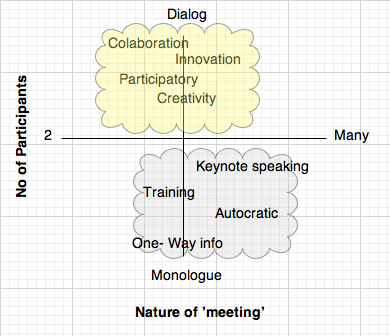
One way to do that could be to map it on a 2×2 matrix with number of participants on the one axis and the degree of interaction from monologue to deep dialog on the other axis .
That could roughly look something like this:
In the bottom half of this matrix there is mainly emphasis on one way info transmission, possibly with a few questions from the floor. This type of meeting is handled brilliantly by various tech solutions and there will be no stopping that trend developing even further. In that sense this type of meeting will slowly disappear from the traditional venues and move to virtual (also because participants are thoroughly tired of attending this type of meeting or conference).
But on the top half of the matrix where the focus is on interaction /participation and deep dialog, high tech solutions do not do the job very well. As Marchall McLuhan said the more complex the message the more complex a medium do you need, and the most complex we have is f2f.
Now if you are providing meeting facilities – go have a look at your breakout room, your standard meeting room set up etc. Are the facilities that you provide conducive to dialog or to monologue?
To me the gray cloud on the drawing represents yesterdays meetings, they will be taken over by high tech solutions and will not require f2f and the yellow cloud represents tomorrows meetings space where we solve the complex and tricky stuff through collaboration and involvement.
The reason i have the number of participant in the matrix is that i see a sweet spot in the 10 to 75 segment ( upper right corner of the matrix) because when you move to very large groups ( upper left of the matrix), and think dialog then tech shows its face aging ( Twiter, FB Etc)
When i presented this to one of my hotelier friends his response was, “but 80% of our meeting business today is Cinema- or U-table set up.” Yes I know i have seen that as well. But if you plot types of meeting on a bell curve then, at the top of the curve (mainstream) you will find the cinema set up and the U-table – fast forward a year or two and where is what was at the top of the top of the bell curve now?
Going down, fast.
At the beginning of the bell curve we now find Dialog, participatory meeting Art of Hosting etc. Where will that be in 2 years time? On its way up, heading for main stream status.
In summary it is going to be increasingly difficult for meeting facility providers to justify that they are providing value when it comes to ‘monologue’ meetings. It can be done better and cheaper with technology – and that type of meeting is a god case for Travel Avoidance”
Where they can make a huge difference and add value is by learning how to provide space and surroundings that are conducive to deep dialog in the broadest sense – and believe me that is not a banqueting room set up cinema style
The new D’Espresso on Madison Avenue (at 42nd) in New York has received more media attention than is generally awarded to a tiny coffee shop in this world of millions of new coffee shops.
The reason for the attention is the fun design by the Manhattan-based nemaworkshop, a team of designers and architects that has created numerous cool retail and hospitality concepts. Founder Anurag Nema took the idea of a coffee shop that looks like a library – giving a nod to the nearby New York Public Library’s Bryant park branch – and turned it on its side. The walls are not lined with books but the floors and ceiling are. Except that it is all an illusion, a life-size image of books printed on custom tiles. Pendant lighting does not hang from the ceiling; it sticks out from the walls.
Maybe it is more than a buzz – maybe it is a fundamental shift..
It started out some years back as just a murmur or a slight rumbling from the initiated. But lately is has slowly risen in volume and my prediction is that before too long it will have gathered further momentum to become an unavoidable roar.
The shift is the call for ‘Purpose’
In a world with limited natural resources, huge inequality, and financial scandals galore, it is no longer comme il faut to do stuff just for money. That applies not just to companies that produce goods and services but is increasingly demanded by individuals as well – a job is no longer just for the money.
A new generation is emerging (see the generation M manifesto). They demand that we do stuff for a reason and it better be a good one – and just in case you are in doubt money is an outcome not a purpose.
The first time this was brought to my attention was 4 years a go sitting on a tree stump in the Rocky Mountains with my friend Lothar Friis. We were having a profound talk about life, business, gigs and all that. And Lothar said “you know in the end it all boils down to one thing: Purpose. If you have a clear purpose you will almost always bee successful in what you do.” That chat stayed with me rumbling around in my subconscious and I started becoming more aware of purpose as a concept.
A conscious business seeks to promote the intelligent pursuit of happiness in all its stakeholders. It produces sustainable, exceptional performance through the solidarity of its community and the dignity of each member.
In the book he says: “People do not consider Business an area to demonstrate their values .. Why not?”. Kofman asks you to think about a person you admire. Why do you admire that person? List the traits on a pice of paper (try it now by the way) What are the values on that list – probably words like integrity, honesty, caring, love, selfishness, you go on… Is that how business and work relations are run – probably not in most cases. Why not ?
He has a point why can’t we run our business with the same set of values that we would like to see in our local community. Well, five year ago you would be told that that is not the best way to maximize profits, but now it seem it just may turnout to be the only way to maximize profits – read on.
Then I read Peter Block’s “The answer to how is Yes” This opened my eyes to the need to ask ‘why’ before we ask ‘how’. The penny dropped. When we ask ‘Why’ we are looking at purpose (If you have not read it please do – it is a very important book.)
“We too often ask “How?” which focuses too closely on the practical way of getting something done and is actually a subconscious expression of society’s emphasis on control of people, time, and cost. Instead, our concentration should be focused on “Why?”. In other words, we need to pay attention to what really matters to us personally, from heart-felt commitments in our private lives to the creation of projects in the workplace. To be able to act on what matters, explains Block, we must reclaim specific qualities, such as intimacy and idealism. Then we can tackle purposeful work as if we were social architects seeking engagement and change.” (Amazon.com)
“Conscious Capitalism is defined to have three elements; that companies should have a purpose transcending profit maximization, are managed for the benefit of all stakeholders and led by evolved, conscious servant leaders.”
By and by purpose has come out of the shadows of idealism and is going mainstream – obviously the financial meltdown of 2007/2008 has help this thinking a lot and contributed to more people have asking the crucial question: Why do we do what we do?
At TED 2010 Simon Sinek presented his ‘Golden Circle’ and showed that the way to the consumers heart starts with ‘why’ and not ‘how’.- Not as new a concept as he would like us to think but he deliveries the message in a very elegant and convincing way. Sinek has also written a great book on this called ‘Start With WHY‘ that I can highly recommend.
“Don’t worry about the level of individual prominence you have achieved; worry about the individuals you have helped become better people. This is my final recommendation: Think about the metric by which your life will be judged, and make a resolution to live every day so that in the end, your life will be judged a success”
And finally this summer Dave Ulrich – not exactly a tree hugger – is out with a new book: The why of Work. Arguing in essence that if your employees don’t understand what you greater purpose is and how they can contribute to that they will be less motivated.
“Alex Bogusky, advertising Dadaist, postmodern media manipulator, pop-culture Houdini, daddy of 21st-century advertising, and now a seeker of meaning on the dirt path of life “ .. “ I guess I just don’t aspire to corporate legacy. I’m convinced that the greatness that matters more is the greatness people achieve through helping each other, through collaborating, more than the greatness that’s achieved by grabbing all you can or getting all you can or building all you can”
If you haven’t heard the cry for purpose – you are not listening – and very soon your customers (and your potential employees) are going to be asking you: “What is your purpose by the way?”. And if you don’t have a compelling answer, they will find someone else who does…
Can webconferences, videoconferences and other virtual meetings really take the place of face-to-face contact?
With travel budgets slashed in the wake of recessionary belt-tightening, companies are increasingly turning to technology as a substitute for in-person contact. Yet business executives overwhelmingly agree that face-to-face meetings are not just preferable but necessary for building deeper, more profitable bonds with clients and business partners and maintaining productive relationships with co-workers.
Predictably the answer to their own survey is that 84% prefer F2F meetings.
But is that the right question to ask if you are trying to understand what is happening in the meeting industry?
Not in my mind it isn’t!
This is the kind of question Kodak asked photographers 5-8 years back: Do you think that digital photos will replace film based photography? No way they all hollered.
This is the question big newspaper publishers asked thier readers 3-4 years ago: “Can you imagine not having a daily morning news paper in print form” Since then a large number of them no longer exist.
This is the question publishing houses where asked 24 months ago “Will the eReader replace books?” – that was before Amazon sold 2 million Kindel’s in 6 months. Now they are not so sure. More on eReaders here
But the reality is this:
This is borne out in Forbes Insights survey, where 58% of respondents said they were travelling for business less today than they were at the beginning of the recession in January 2008, with more than a third (34%) indicating they were travelling much less frequently.
This is my point, it may not be what they prefer – but this is what they do – not because it is better but because it is cheaper, and more convenient.
Surevy: would you prefer to fly Business or Turist?… No brainer right?
But why is tourist class then jam packed and Business reduced to 2 rows that are half empty on many European flights? It is not what we would prefer. It is what we do.
The big danger is that we in the industry stick our heads in the sand as a result of surveys like this – pat each other on the back and knowingly nod to each other: “f2f meeting are better – we know that – they know that. All will return to normal soon, you just wait and see….”
I don’t think so
That is what KODAK thought
The question we should be asking is : Is the market broken? – see this by Seth Godin: “What every mass marketer needs to learn from Groucho Marx”
See also my previous post on this subject: Is the meeting industry doomed?