“Every act is a marketing act. Make every employee a marketing person.”

Enthusiastic or Just Satisfied?

Most people intuitively understand that if you are delivering a product or a service, you will not earn money if you have unhappy customers. There is a basic understanding that we need to keep an eye on customer satisfaction. And there is nothing wrong with that. But it is just not enough.

A basic misconception is that customer satisfaction as such will lead to prosperity. This is clearly not the case.

Mere satisfaction does not lead to growth and prosperity.

Satisfaction may just be enough to keep you in the game. In fact, Fred Reichheld and his research team have shown that 60–80% of customers who defect from companies scored “satisfied” or “very satisfied” in customer surveys immediately prior to their dumping a given supplier.

So what does it take to really drive profit and growth? According to the original SPC research, customer loyalty is the key. A strong link exists between high customer loyalty and profit. The reason for this is twofold. The “traditional” explanation is that it is much cheaper and easier to sell to existing customers. If you have a large, loyal following, you do not need to spend as much on advertising or PR to acquire new business. This still holds true, but the main reason that loyalty is a key driver of profit has to do with the ambassador effect. Loyal customers tell their friends.

They become brand ambassadors or, in Reichheld’s terms, promoters. As discussed in the first chapter, in an oversupplied world, traditional advertising becomes less and less effective. Just as we know from the bazaar, everybody is trying to shout louder than the guys in the stall next door.

3000 messages a day

Urban dwellers are subjected to around 3,000 messages a day from companies trying to influence their behaviour in one way or another. Sounds like a big number? Just run a typical day through your head and consider the inputs you are subjected to during that period from the radio, television, Internet banners, pop-up windows, newspapers, billboards, the sides of buses, sugar sachets, and toilet doors. The creativity that goes into thinking up new ways to stick messages in front of potential buyers is impressive.

But as marketing guru and author Seth Godin has pointed out again and again, this is interruption marketing.
We are disturbed by messages, 99% of which do not concern or interest us one bit. To the extent that we notice them, they may even produce the opposite effect – they annoy us. As a consequence, we develop a kind of message immunity and simply ignore such messages. Add to that, that the trust level that consumers have related to what they hear from advertisers has been steadily dropping for a long time now. Even if the product per se interests us, we do not trust the message from the vendor.

So whom do we trust?

Think about it. When faced with an important purchasing decision, what do you do? One option is to thoroughly research the products yourself, comparing performance, price, reliability, and service. Or maybe you consult consumer research magazines and Web sites. You too live in a world with ever more things to do and less and less time to do them in. So if you are like most of us, you go for a short cut, which is nearly always to ask someone you trust for an opinion.

In my case, I would not dream of entering into an agreement with a new training venue without checking with a few of my trusted colleagues. Maybe I will first do some research on the Web and discover an interesting venue that markets itself as the “Trainer’s Paradise”, state-of-the-art facilities, great food, and service. Sounds like just what I need. But I’ll then call my friend and trainer colleague Peter and ask him, “Have you been there? What do you think?” He may say, “Yes, the facilities are great, but the receptionists are just so pretentious.”

Well, that’s the end of that. There is no shortage of training venues, so why take a chance? I continue my search on the Web for something else. But, unfortunately, that is not the whole story. It gets worse. My friend Louise calls me the following week and asks me about the “Trainer’s Paradise”. “I am considering booking the ‘Trainer’s Paradise’ next month. Do you know it?” Chances are that I will reply, “I have not been there myself, but I have heard from others that it is lousy; can’t remember what the problem was, but if I were you, I would try and find something else.” Is that fair? No, it is not. My friend Peter may just have had a bad day; he may have been totally unreasonable, whatever. But I don’t have the time to investigate that further and I don’t need to; in an overcrowded market there is plenty of choice.

As a consequence, anyone delivering a service product lives on a knife’s edge every hour and minute of the day.

Every transaction you enter into with a client is potentially a marketing move that will promote or discourage future business. The good news is that this is also the only marketing you will ever need – apart from a Web presence – and you can save a lot of money if you get it right. In the service business, marketing is what we do on a daily basis. The way we meet and greet, the way we deliver what we do, the way we say goodbye – that is marketing. Don’t squander your money on trying to make more noise than your neighbour.

Nobody is listening anyway.

The above post is an excerpt from my book ” Best! No need to be cheap if you are..” you can find it here

“This book is addressed to individual managers who work in all aspect of the service industry, this volume is aimed at helping them first, to understand how the industry has changed, and changed dramatically, over the past few years.

With that basis, Mike Hohnen explains why and describes how such managers can focus their efforts in order to stand out in the marketplace, while avoiding, getting caught in the trap of unproductive and detrimental responses. Additionally, he explains how managers can get their people involved in the crucial task of turning customers into ambassadors, allowing word of mouth to work to their advantage.

Mike’s approach is rooted in the principles of the Service-Profit Chain described by Heskett, et al. in their book published by Harvard in the 1990′s and widely recognized as the foundational academic research on the subject”.

LeadershipLab –

What a great way to do that!

About 9,600 managers cycled through the temporary interactive experience–raking coffee beans, watching roasting demonstrations, learning company history, and most importantly, soaking in the Starbucks brand as they went.

FastCompany

The job that needs to get done.

Clayton Christensen – in his book The Innovators Dilemma has done a great job of explaining to us all why it is that time and again market leaders get ambushed by much smaller new entrants. If you have not read it please do it’s a fascinating read.

The classic scenario is that the much smaller new entrant launches a product that is obviously inferior from a quality point of view and therefore the existing players in the market don’t take it seriously. Ryanair is a good example of this and before them, Japanese car makers ambushed the American automobile industry with their compact cars.

And just now we are witnessing that the traditional newspaper industry is flapping around like headless chickens trying to come up with a business model that will save them from disappearing altogether – but they too woke up to late.

The key to understanding why this happens again and again is that established providers focus on their core customers and in that process lose sight of the job that needs to get done.
Take journalism, the demand for news is the same – but the way it is consumed has changed. My grandfather had the maid iron his newspaper before it was brought to him in his study. Well not many people consume news that way any more if you get my drift – but they still need it and somebody is providing it.

The reason I’m taking this up in my blog is because I have noticed how hugely popular a number of essentially couch surfing services have become. Airbnb seems to be the most visible but there are many others.

The concept enables private people to rent out their spare space to travelers. In Berlin a popular tourist destination hoteliers are now asking for government intervention, new rules and regulations because it is estimated that a whopping 5,000,000 bed nights a year are being supplied by private vendor’s. Interesting. Big chains are feeling threatened by small private vendors. What is going on?

Well, if we look at it through the lens of the job that needs to get done my interpretation is that this is not just about price – lots of private vendors are charging the same or more than your average budget hotel. I think this has more to do with hospitality – or the lack thereof.

If you visit a site like Airbnb.com and pick any popular city and look at the comments that some of the popular providers have on their listings from satisfied guests. What visitors appreciate is clearly the personal touch. The host that catered to a particular need, showed them the right dance club or whatever – in every case of a raving review it is clear that there was a real connection between the host and the guests. And that to me is what hospitality has always been about. That is the job that needs to get done.

But lately we have seen especially budget and mid priced hotels automating and streamlining their processes in order to cut costs. Check yourself in and out. Pick up your breakfast in the automate etc. But in the process they threw the baby out with the bathwater.

The obvious success of the couch surfing services is a big wake up call for the industry – we need to refocus on the job that needs to get done – which means being great hosts.

No value no business (redux)

Average is over!

The above title is from a recent column in the New York Times by Paul Krugman. In it Krugman makes the point that in the past and average person with an average education could do an average job and earn an average income without too much sweat. But today as digitization, automation and cheap labor is easily accessible to all it takes more than average to make it. This means writes Krugman that everyone needs to find their unique value contribution that makes them stand out in whatever is their field of employment.

If you think about it that’s not just on a personal level. That also applies to any imaginable company, product or service.

No value no business

But how do we actually define value?

Firstly, we must always keep in mind the value can only be understood from the customer perspective – which means it is highly subjective.

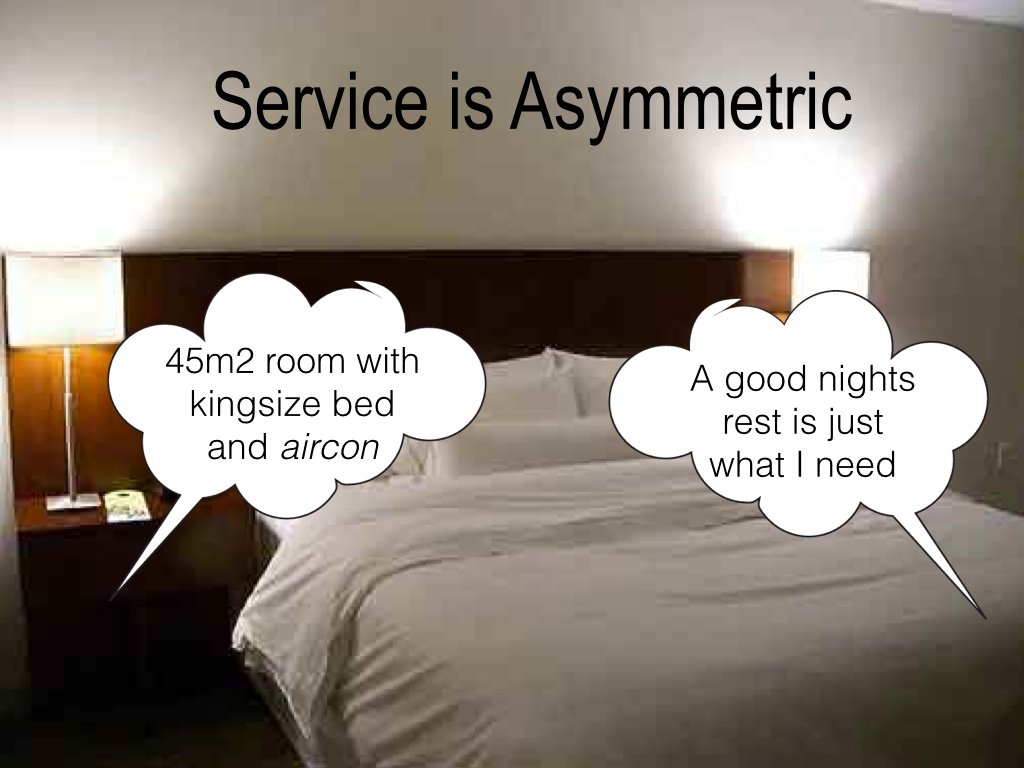
Secondly, in all service businesses there is a phenomenon of asymmetry. By which I mean that what the customer actually purchases is not what we sell.

The simple version of this is when you book a hotel room you are in the market for a good nights sleep but what the hotel provides you with is a room and a bed.

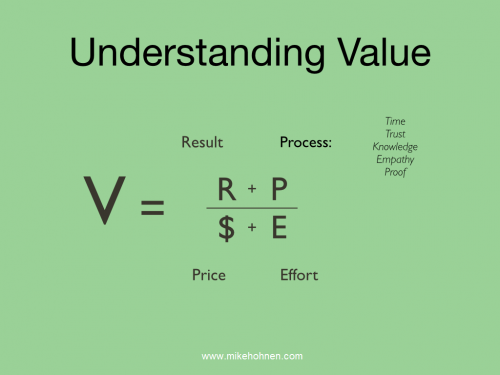
If we then look at the research documented in the service profit chain there is a very neat formula for understanding value from the customer perspective called the value equation:

Value Equation

Value equals Result (R) + Process (P) / ($) Price + (E) Effort

The process part can then be broken down further in to 5 components : Time, Reliability, Competency, Empathy and Proof of delivery.

With this little equation we can map any existing or future service experience/product and in the process understand what the value proposition is. And more importantly what can be tweaked in order to increase value.

The most important part is the ‘Result’ part of the equation. As consultants we can be asked to deliver what on the surface essentially seems the same service but actually provides or fulfills different result needs for different clients. (When hiring a consultant clients can be looking for, a solution, reassurance, someone to do the dirty work, an excuse to postpone something etc) so we can only deliver value once we have a very clear understanding of the Result that is to be provided. Once we know that we can tailor the process and the 5 variables that comprise the process in order to maximize the Result part.

The higher the value we provide above the line more room there is for a payment under the line.

The E-part of the equation relates to how much effort the customer needs to put in apart from what they pay for it. Simply put the easier we make their life – the more value they see.

To better understand the equation try for yourself.
If you have the guts map out your own job. If you’re less courageous just try a-product or service that your company delivers

Happy staff make more money… for you

…companies that effectively appreciate employee value enjoy a return on equity & assets more than triple that experienced by firms that don’t. When looking at Fortune’s ’100 Best Companies to Work For’ stock prices rose an average of 14% per year from 1998-2005, compared to 6% for the overall market.” read the Forbes article here

This is a quote from study cited by a new book out by Dr. Noelle Nelson entitled : “Make More Money by Making Your Employees Happy,

For regular readers of this blog this is a well-known theme.

I’m always amazed how much attention this kind of message actually gets: Everybody goes . ohh surprise.. look at this…happy staff is important.

Because if you think about it it is so self evident. In a hyper-competitive world where products are more lookalike than unique, ultimately what makes a difference is the relationship factor.

And the relationship factor is what takes place between your front-line employees and customers.

The missing link

What a lot of people however totally miss in this connection is what it actually takes to keep front-line employees happy and comfortable with their jobs. The big misunderstanding is that it’s a question of more money, perks or friendly pats on the back. It’s not.

As Hertzberg taught us many many years ago, the basics, money work conditions etc, need to be on par with industry standards and if you get that right you can prevent dissatisfaction – Hertzberg called these hygiene factors. But it does not create motivation or the kind of enthusiasm that is needed for front-line employees to actually enjoy building those crucial relationships with customers.

From my perspective employee satisfaction is relatively uninteresting – what really counts is employee enthusiasm. Enthusiasm is what makes a service organisation stand out head and shoulders above the rest.

And the primary driver of enthusiasm on the job – which has to do with job content , what a person is allowed to do – is that person’s immediate supervisor.

The immediate supervisor builds or kills enthusiasm.

So if we want to build a service organisation that is among the best we need to make sure that our middle management team understands the crucial role that they play in this connection.

It is as simple as that.

Google Find us on Google+