
Service Design Thinking is a fantastic toolkit for improving our customer service experiences. Mapping out customer journeys, identifying touch points and understanding different customer personas is going mainstream as everyone chases the elusive super loyal customer.
But did we get the wrong end of the stick?
Let just backtrack for a moment and ask ourselves the fundamental question: why are we so focused on the ‘experience’?
Because in order for something to qualify as service, it has to fulfill two criteria.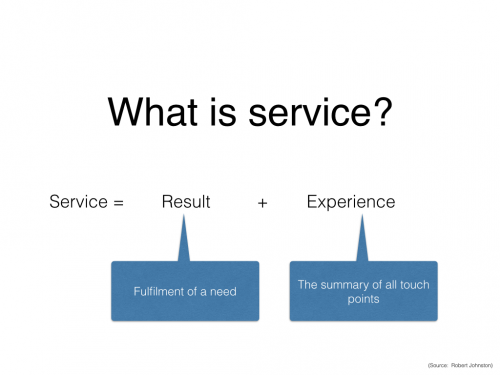
It needs to deliver a certain result and there needs to be a positive experience.
If you walk into your favourite coffee shop and they serve you a horrible wishy-washy cup of latte, the setting may be nice and the lady may be ultra friendly but your basic result was not delivered.
Or the other way round.
The coffee is great, but the place is filthy and noisy, the lady is rude. The result was delivered but the experience was horrible. You could just as well have made that cup of coffee at home and saved yourself quite a few bucks. When you opted for going to the coffee shop, you were looking for a service, not just a product.
Ok so far so good. Sometimes it can be sobering to get back to basics.
So assuming that you know how to deliver the result part of whatever service you offer, let’s examine the experience part. As Seth Godin says, customer service is all about changing feelings. Experiences are emotions in action. No emotions, no experience. How was your train commute to work today compared with the same day last year? Ehhh?? Most probably you can’t remember because if it was just the way it always is, there was no emotion. You have not stored it in your memory as ‘an experience’ (Technically everything is an experience but we only retain in our memory the positive and the negative ones, the rest is auto-deleted).
“The only purpose of customer service is to change feelings.”
– Seth Godin
So as you look at your customer journey and map out the touch points, it’s a good idea to also map the emotional highs and lows. You can start out by estimating them but eventually, you will need to research and confirm your assumptions.
Let’s map a simplified example of a customer journey most of us can relate to, the airport check in: Arrive at airport, check in on the touch screen, walk through security, walk to the gate, board using automated boarding card verification, greeted by stewardesses, Settle into a seat.
What are the potential emotional highs and lows that we could work on to ensure that we maximise the experience? The touch screen provides no emotion unless it is not working, so it is just a negative risk. Walking the hallways can at best be neutralised by making the walk pleasant on the eye and informative. Boarding card verification is again automated. The automated or physical parts of the journey we can work on to eliminate negative emotions but they are hard to turn into over the top emotionally positive experiences.
The the two touch points that have the potential to provide emotional highs are the security check and the welcome onboard greeting by the hostess. The critical variable in achieving this is obviously the human being involved in these two touch points. The customer experiences are in their hands and totally dependent on how they feel (Technically we call that engagement, but that is actually just a fancy word for their feelings toward the job.) If they feel anything less than enthusiastic, they will deliver the minimum required to keep the job.
But, you may say, we give them a service manual and they get the onboarding service course, they know what they are supposed to do. Yes, they know, but knowing and doing is not the same thing. They will do or not do depending on how they feel.
In order to understand what drives their emotions, we need to map their employee experience. What is it like to be an airport security agent or a flight attendant? How does their employee journey unfold on a daily basis? What are the emotional highs and lows? Do we know and what can we do to maximise the highs and eliminate or neutralise the lows? (In a Service Profit Chain context, we would call this improving internal quality.)
If you are really serious about delivering best in class customer experiences, you need to start at the other end and look at what kind of employee experience you are providing that is your foundation. Great service design pasted on top of mediocre employee experiences is like trying to paint over the rust spot on a used car.
You can download the Dream Team Checklist below and benchmark yourself!









 This the sixth blog post in a series where Mike is exploring: Why and how to develop not just yourself but also the people around you?